
Table of Contents
- What Makes Printable Mahjong Cards Good Quality
- Printable American Mahjong Card vs. Official Cards: A Direct Comparison
- American Mahjong Card Size and Printability
- Large Print Mahjong Card Options for Better Readability
- Paper and Printer Settings That Determine Quality
- Free Printable American Mahjong Cheat Sheet Resources
- Common Mistakes That Ruin Printable Card Quality
- Frequently Asked Questions
Last Updated: October 15, 2026
What Makes Printable Mahjong Cards Good Quality
Whether are printable mahjong cards good quality depends on three factors: resolution, paper weight, and color accuracy. Get them right and your cards rival official sets; get them wrong and you get faded tiles and bent corners.
The first mistake most players make is printing on standard office paper, which tears easily and looks cheap after two game nights. Cardstock in the 80-110 lb range transforms a printable card from disposable to durable.
Resolution matters just as much. A 300 DPI file looks crisp; anything below 150 DPI produces blurry tile icons and smudged numbers. This matters most for players over 55 or anyone with vision challenges, where poor print quality turns a reference tool into an eyestrain liability.
Color accuracy varies with your monitor, printer, and ink settings, so what looks perfect on screen may print darker or lighter. Professional services like Staples, FedEx Office, or Costco calibrate regularly and often produce more consistent results. At home, adjust your color settings and run a test first.
Printable American Mahjong Card vs. Official Cards: A Direct Comparison
Official American Mahjong cards are printed on heavy cardstock and include annual hand updates. The trade-off: you wait for shipping and are locked into the manufacturer's design.
Printable cards start at $4.95 per design and let you choose your artwork, with instant download. The catch: quality depends entirely on your printer, paper, and file resolution. A poorly printed card looks worse than an official one; a well-printed card looks just as good.
| Aspect | Official Cards | Printable Cards |
|---|---|---|
| Cost per set | $8-$15 | $4.95-$17.95 |
| Delivery | 5-10 business days | Instant download |
| Design options | Limited | Extensive variety |
| Annual updates | Included | Requires new download |
| Print quality consistency | High (factory controlled) | Variable (depends on your setup) |
| Best for | Casual players, clubs | Customization, quick access |
The real advantage of printable cards emerges when you need multiple sets fast, for a club tournament next week or a themed party. Official cards won't arrive in time; printable cards print today. At AmericaMahjongfun.com, designs range from vintage wine-themed cards to floral lucky tiles, each an instant download with high-resolution PDF and JPEG files. You can choose five designs in a bundle and save 27% versus buying individually.
Where official cards win is consistency: a factory controls every variable, your home printer doesn't.
American Mahjong Card Size and Printability
Standard American Mahjong cards fold to 5" × 7", the size of a traditional greeting card. Most printable files print on a 10" × 7" flat sheet that folds in half, fitting standard greeting card envelopes.
Large-print options exist for players with vision challenges, enlarging tile symbols and hand notation. The trade-off is fewer hands per page, but if readability matters more than a compact reference, they're worth the extra space.
Printability depends on your printer's margins. Most home printers require 0.5" on all sides, so a 10" × 7" design may not print edge-to-edge without trimming. Check your printer's specs before downloading; professional print shops handle edge-to-edge more reliably for a small per-card fee.
Large Print Mahjong Card Options for Better Readability
Large-print American Mahjong cards enlarge tile symbols, hand names, and scoring notation. For players over 65 or anyone with low vision, this makes the difference between playing comfortably and squinting through every hand.
The challenge: larger text means fewer hands per page. A standard card might show 15-20 hands; a large-print version shows 8-12. That's fine for a full reference set, but an issue for a compact scorecard to carry in your purse.
Some players keep large-print pages at the table and reference standard-print cards for quick lookups, getting readability when needed and portability when not.
AmericaMahjongfun.com's designs include floral accents and rose-gold highlights paired with clear, readable tile layouts. The 3D Mahjong Birthday Card design, for example, uses high contrast and spacing that improves readability without a separate "large print" version.

Paper and Printer Settings That Determine Quality
Paper weight is the biggest factor in perceived quality, but it's only the first of five variables that decide whether a printable card survives a season: ink type, print resolution, finishing, and storage.
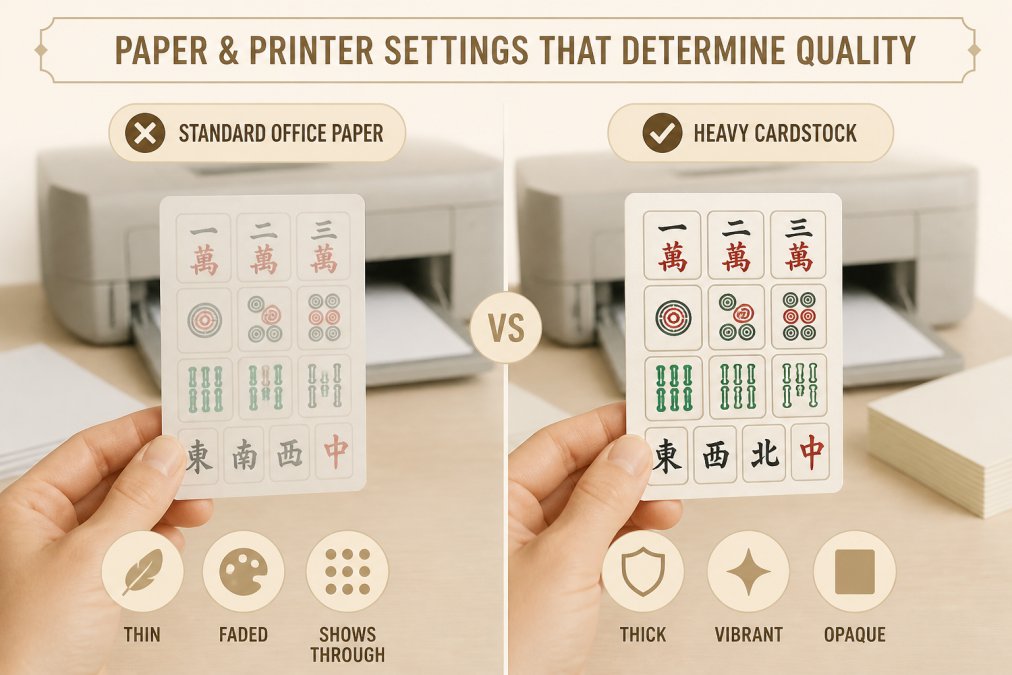
Paper stock. Standard copy paper is 20 lb bond; cardstock is sold by cover weight, and 80-110 lb cover works for a folded mahjong card.
Ink type. Dye-based inkjet ink gives the most saturated colors but smears when damp and fades faster. Pigment ink resists water and fading but looks duller on glossy stock. Laser toner keeps edges crisp but can flake if folded sharply across a printed area.
Resolution and scaling. Print at 300 DPI minimum and set the dialog to 100% or Actual Size.
Finishing. Three options, in ascending order of durability:
Mahjong Birthday Card Bundle — 5 Printable Cards • Save 27% →
- No finish. Cheapest. The card is vulnerable to spills, fingerprints, and edge wear. Expect visible softening within a month of weekly play.
- Cold lamination or self-adhesive sheets. Adds a wipe-clean surface and stiffens the card. Cold (pressure-sensitive) lamination avoids the heat that can distort dye ink. Trim flush to the edge or the laminate peels.
- Hot lamination pouches. Most durable and most rigid, but the card no longer folds unless you laminate the two halves separately and hinge them with tape. Best for flat reference sheets rather than folded cards.
Durability testing. Before committing a full set, test one card: fold and unfold it 20 times, shuffle it against official cards for a few minutes, and wipe it with a damp cloth.
Storage. Keep finished cards flat in a rigid sleeve or small box rather than loose in a bag, and away from direct sun, since UV fades dye ink faster than anything else here.
Professional print shops handle paper, ink, and finishing: upload the file, choose a stock weight, and pick it up within 24 hours. The trade-off is cost per card and less control over lamination.
Free Printable American Mahjong Cheat Sheet Resources
A cheat sheet is only useful if it's correct. The hard part isn't finding a printable reference, it's confirming the hands, scoring, and notation match the current year's card. Most free resources skip this step, and it's where printable references earn or lose their reputation for quality.
Where free cheat sheets come from. Community forums, local club websites, and shared drive folders are the usual sources, ranging from a clean one-page summary to a scanned photocopy with unreadable tile glyphs.
Why annual updates matter. American Mahjong hands are revised every year, and a prior-year card lists combinations no longer valid. An outdated cheat sheet causes real disputes when a player calls a hand the current card doesn't recognize.
A verification checklist before you print or play. Run every printable reference, free or paid, through these steps:
- Check the year. The sheet should state the card year it corresponds to. If no year is printed, treat it as unverified.
- Confirm the source. Prefer sheets published by a named club, league, or vendor over anonymous uploads with no attribution.
- Spot-check hands against the official card. Pick three or four hands from the sheet and confirm they appear on the current official card with the same tile counts and suits.
- Check scoring notation. Confirm point values and the bonus/doubles rules match the current card, since these change alongside the hands.
- Check tile diagrams for legibility. Zoom in on the smallest symbols. If a printed tile is ambiguous at 100% scale, it will be ambiguous on paper too.
- Check the layout for missing content. Count the hands listed against the official card. A sheet that quietly omits a category is worse than no sheet, because players assume it is complete.
- Re-verify after any update. If you reprint for a new year, repeat steps 1 through 6 rather than assuming last year's file was refreshed.
Free versus paid, on accuracy grounds. Free sheets can be perfectly accurate, but you carry the verification burden. Paid references typically include the current year, a consistent layout, and a named publisher to contact. The value isn't the paper, it's the reduced risk of playing from a stale hand list.
Using a cheat sheet well at the table. Print one sheet per table for clubs so new players can check hand validity without stopping the game, and keep a second copy in a page protector against spills.
A printable cheat sheet is a reference tool, not a substitute for the official card. Verified against the current year, it speeds up play and settles arguments; treated as an authority on its own, it will eventually cost you a hand.
Common Mistakes That Ruin Printable Card Quality
The most common error is printing on standard office paper. Players assume "paper is paper" and grab whatever's in the tray, ending up with a card that feels cheap, tears easily, and fades after a few games. Cardstock costs only slightly more per sheet and transforms the experience.
Another frequent mistake is ignoring printer margins. A 10" × 7" file designed for edge-to-edge printing gets shrunk when your printer's default margin is 0.5", making tiles smaller and text harder to read. Check your printer settings before printing.
Printing without a test page wastes cardstock. A single test on regular paper reveals alignment, color, and sizing errors before you commit to expensive stock, and pays for itself immediately.
Not updating annual hands is a subtle but important mistake. American Mahjong hands change every year, so a printable card from 2024 lists hands no longer playable in 2026. Always verify your downloaded file reflects the current year's rules. When you purchase from AmericaMahjongfun.com, the files you receive are current for this year.
Folding before ink dries leaves smudges and color transfer. Wait 30 seconds after printing before handling to preserve the card's appearance.
Whether are printable mahjong cards good quality comes down to execution. AmericaMahjongfun.com's printable cards, from the Mahjong Birthday Card Bundle to individual designs like the Funny Mahjong Birthday Card with wine-lover theme, deliver high-resolution files designed for home printing. Pair them with cardstock and the right settings, and you'll have cards that last through seasons of play.

Frequently Asked Questions
Are printable mahjong cards the same quality as official cards?
Printable mahjong cards can match official card quality if printed correctly on the right paper, but they require more effort. Official cards come pre-laminated and ready to use, while printable cards depend entirely on your printer, cardstock weight (80-110 lb recommended), and print settings.
What paper should I use for high-quality printable American Mahjong cards?
Use heavyweight cardstock between 80-110 lb for the best results. Matte cardstock provides a premium finish and reduces glare, while gloss cardstock makes colors pop but can feel slippery during play. Print at 100% actual size using Adobe Acrobat Reader, and select 'Flip on Long Edge' for double-sided printing. Let ink dry completely before folding to prevent smudging.
Can you play American Mahjong with a printable card if you print it correctly?
Yes, absolutely. A correctly printed card on quality cardstock works perfectly for gameplay. The key is ensuring accuracy, verify the card matches the current year's official hand patterns, as American Mahjong hands change annually. Print at actual size (100%), use 300 DPI resolution files, and print on cardstock rather than standard paper. Many players prefer printable cards for practice games and club meetings.
Do you need a new American Mahjong card every year?
Yes, the official American Mahjong card updates annually because the standard hands change each year. If you're playing in tournaments or official club games, you need the current year's card. Printable cards make this easy, you can download and print the updated version instantly without waiting for shipping. Casual home games may use older cards, but competitive play requires the current year's version.