
Table of Contents
- Why Joining a Local Mahjong Club Matters
- Mental Benefits of Playing Mahjong
- Social Benefits of Mahjong
- What to Expect at a Mahjong Club
- Mahjong Club Games and Activities
- How to Find and Join a Local Club
- Frequently Asked Questions
Last Updated: October 5, 2026
Why Joining a Local Mahjong Club Matters
The benefits of joining a local mahjong club extend far beyond the tiles themselves. Regular play with a consistent group touches nearly every aspect of your well-being. At AmericaMahjongfun.com, we believe the real payoff isn't winning hands, it's building friendships, sharpening your mind, and finding a place where you genuinely belong.

What makes a mahjong club different from casual play at home? Consistency, structure, and a community that expects you. The benefits of joining a local mahjong club are measurable and immediate: mental engagement, social connection, stress relief, and the joy of gathering with people who understand why this game matters.
Mental Benefits of Playing Mahjong
Playing mahjong demands constant mental work. Every hand requires you to track discards, anticipate what others need, and adjust your strategy in real time, pattern recognition and strategic thinking happening simultaneously.
The cognitive engagement is relentless in the best way. Memory comes into play immediately: which tiles have been played, which players discard certain suits, what winning combinations are still possible. Over months of regular play, these demands can contribute to improvements in recall and adaptability (pubmed.ncbi.nlm.nih.gov).
Many players find that the mental stimulation can carry into everyday life. The focus required at the table can translate into better concentration, and the pattern recognition may sharpen your ability to spot connections elsewhere. For some, being fully present with the tiles becomes a form of stress relief in itself.
Social Benefits of Mahjong
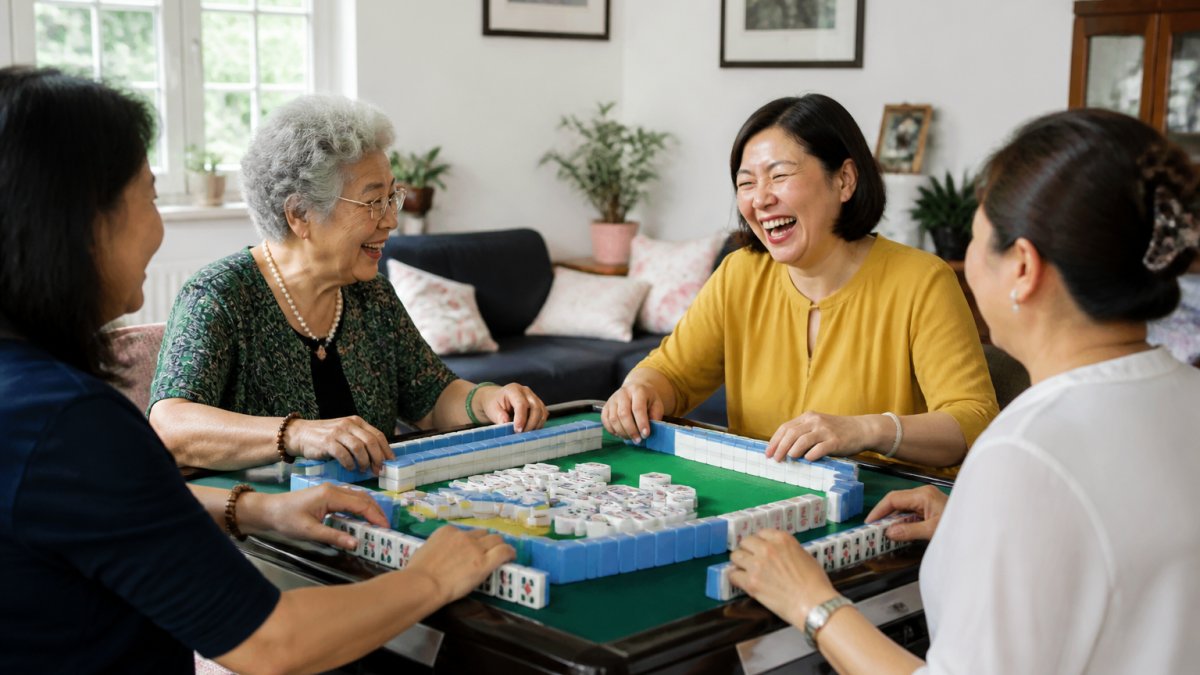
A mahjong club is fundamentally a gathering space. You show up, sit at a table with three other people, and for hours you're in conversation, laughter, and shared focus. The social benefits of mahjong are immediate and ongoing.

Meeting new people happens naturally, you're not at a networking event, you're at a table where conversation flows around the game. After a few weeks, you know the regulars: who plays aggressively, who plays conservatively, who cracks jokes between hands. You're not a newcomer anymore; you're a member of the group.
Mahjong clubs often develop traditions: the same players on the same nights, the same snacks, the same stories retold and laughed at again. This consistency builds something deeper than friendship, belonging. You're expected, missed when absent, and your presence matters.
For many players, especially those in retirement or life transitions, a mahjong club becomes a primary social anchor, a reason to get out, get dressed, and be part of something. Intergenerational participation adds another layer: grandmothers play with daughters, younger enthusiasts alongside players in their seventies and eighties.
What to Expect at a Mahjong Club
Walking into a club for the first time is the part most articles skip. Here is the honest walkthrough, hour by hour.
Before you arrive. Confirm the start time and address, and ask whether the group eats before, during, or after play, many clubs build in a meal or snack break. Bring the current National Mah Jongg League card if you have one, a small amount of cash, and reading glasses if you use them.
The first fifteen minutes. You'll arrive to tables already set up, square tables with four chairs, each place holding a rack, tiles, and a scorecard. Introduce yourself to whoever seems to be organizing and say plainly that it is your first time.
Do you need a partner? No. Mahjong is a four-player game, and clubs exist precisely so that individuals can be matched into tables. You will be seated with three other players, often a mix of experience levels.
Equipment and the card. The club supplies tiles, racks, and dice; you supply the League card, which lists the current year's winning hands and is updated annually.
How a session actually runs. A typical meeting lasts three to four hours and covers eight to twelve hands. Play begins with seating and wind assignment, then the wall is built, tiles are dealt, and the first hand starts.
Etiquette you will be expected to know. A few unwritten rules matter more than any strategy tip:
- Announce your discard clearly so the table can hear it.
- Do not touch the wall or another player's tiles.
- Do not offer unsolicited advice during a hand; save coaching for between hands.
- Keep conversation light while tiles are live, and save stories for the break.
- If you are unsure of a rule, ask before you act, not after.
- Pay attention to whose turn it is; playing out of turn disrupts the whole table.
What people actually say at the table. Experienced players will comment on your play, "that was a risky discard," "you are playing too defensively." This is not criticism; it is how the club teaches, and a sign you're being treated as a real player rather than a guest.
Skill levels and table matching. Most clubs seat by experience, with a beginner table, an intermediate table, and one or more advanced tables. If the club does not do this, ask the organizer to seat you with patient players for your first few sessions.
Atmosphere varies widely. Some clubs are quiet and competitive with strict rules and small stakes; others are loud, social, and play for fun only. Most sit in the middle: serious about the game, relaxed about everything else. Many players try two or three clubs before settling in.
Mahjong Chic Chicks Tee | Vintage Glam Mahjong Graphic Shirt →
When you leave. Before you go, tell the organizer you would like to come back, and ask what you should bring next time. That one sentence turns a first visit into a standing invitation.
Mahjong Club Games and Activities
A typical mahjong club meeting runs 3-4 hours, enough for 8-12 hands, depending on pace and how much the group talks between rounds.
The games follow American Mahjong rules and the National Mah Jongg League card, which changes annually and defines what combinations win. This standardization means you're learning a consistent system, and you'll have the card memorized faster than you expect.
Beyond regular play, many clubs organize special events: seasonal tournaments, charity events, themed game nights, and celebration gatherings. These keep the club feeling fresh and give members something to work toward.
Mahjong club games and activities also include teaching moments. Experienced players often help newcomers understand strategy without taking over the game, and some clubs dedicate sessions to beginners or hold informal classes before regular play. Most clubs expect stronger players to help develop weaker ones.
The scoring system can become familiar quickly. Most clubs use a point-based system tracking wins and losses across sessions; some have small stakes (quarters or chips), while others play for fun only. Either way, the tracking can create continuity.
How to Find and Join a Local Club
Finding the right club is a short project, not a mystery. Most players locate their group through one of five channels, and the fastest path is usually to try two or three rather than committing to the first one you find.
Where clubs actually meet. Community centers, public libraries, senior centers, places of worship, and neighborhood association rooms host most recurring groups. Some meet in members' homes on a rotating basis; a smaller number use dedicated game rooms or rented event spaces. If you live near a retirement community, its activity calendar is often the richest source of weekly mahjong listings.
How to search. Start with a plain search for "mahjong club near me" plus your town name. Then check these specific places, in this order:
- Your public library's online event calendar (many list recurring game days)
- Your city or county parks-and-recreation program guide
- Senior center newsletters and bulletin boards
- The National Mah Jongg League's club and tournament listings, which many organized groups register with
- Local Facebook groups and Nextdoor posts, where members often recruit for open seats
- Meetup, which hosts both casual and competitive groups in larger metro areas
The contact script. When you reach an organizer, ask five questions before committing to a visit: (1) What day and time do you meet, and how often? (2) Do you play American Mah Jongg with the current League card, or a different variant? (3) How do you handle brand-new players, beginner table, teaching session, slower pace? (4) What does it cost per session or per year, and what does that cover? (5) Do I need to bring anything besides the card? A good organizer answers all five without hesitation; vague answers are useful information.
Cost models you will encounter. Clubs generally fall into four pricing patterns:
| Model | Typical structure | Best for |
|---|---|---|
| Free / donation | No dues; optional contribution for room or snacks | Casual players testing the waters |
| Pay-per-session | Small per-visit fee collected at the door | Players with irregular schedules |
| Annual membership | Yearly dues covering room rental, supplies, and sometimes the League card | Regular weekly players |
| Hybrid | Low annual dues plus a small per-session fee | Clubs with higher overhead |
Ask specifically what the fee covers. Room rental, tile sets, racks, scorecards, and the annual League card are the usual line items. A club that charges dues but asks members to supply their own card is normal; a club that charges dues and provides nothing is worth a second look.
Accessibility and fit. Before your first visit, ask whether the meeting room has elevator access, whether parking or transit is nearby, and whether the group welcomes players who need a slower pace or a written rules reference at the table. Most established clubs accommodate these needs; the ones that don't will tell you quickly, saving you a wasted trip.
Your first-visit checklist. Bring the current National Mah Jongg League card if you own one (or buy one at the club, they're inexpensive and sold through the League), a small amount of cash for per-session fees or small stakes, and reading glasses if you use them. Arrive ten minutes early so you can be seated before the first hand, and bring a willingness to lose your first several games, every regular at the table paid that entry price too.
Frequently Asked Questions
What are the main benefits of joining a mahjong club?
Joining a mahjong club provides cognitive engagement through pattern recognition and strategic thinking, social connection with fellow players, stress relief through focused gameplay, and a sense of belonging to a community. The combination of mental stimulation and social interaction creates a well-rounded hobby that supports overall well-being.
What should I bring to my first mahjong club meeting?
Most clubs provide tiles, racks, and all game materials, so you typically don't need to bring equipment.
Can playing mahjong help with mental health and stress relief?
Yes. Mahjong requires focus and strategic decision-making, which keeps your mind engaged and present during play. This mindfulness aspect can naturally reduce stress by shifting attention away from daily worries. The combination of cognitive engagement and social connection can create an effective stress-relief activity that supports emotional well-being.
How often do mahjong clubs typically meet?
Most local clubs meet weekly, though some gather bi-weekly or monthly depending on membership preferences and scheduling. Weekly meetings are common because they provide regular social connection and allow players to develop friendships and improve their skills consistently. Some clubs also host special events, tournaments, or themed gatherings beyond regular game nights.