
Table of Contents
- What You Need to Host a Mahjong Night
- Choose Your Mahjong Ruleset and Learn It First
- How to Teach Mahjong to Beginners
- Create Your Mahjong Night Invitation Wording
- Plan Your Mahjong Night Schedule
- Common Beginner Mistakes to Avoid
- Set the Scene: Atmosphere, Snacks, and Refreshments
- Frequently Asked Questions
Last Updated: October 7, 2026
What You Need to Host a Mahjong Night
Hosting a mahjong night for beginners starts with the right equipment and setup: a mahjong set, comfortable seating, and materials to help new players learn.
Essential Game Equipment
A quality mahjong set is your foundation. Most standard sets include 144 tiles, four tile racks, dice, and a wind indicator. Check that all pieces are present before your guests arrive.
Beyond the tiles themselves, consider adding a few extras:
- A score sheet or note pad for tracking points
- A money dish (like the Mahjong Money Dish from AmericaMahjongfun.com) to hold coins or betting quarters
- A timer for keeping rounds moving
The money dish holds quarters for scoring and adds a decorative touch to your table.

Table Setup and Comfort
A standard mahjong table is 36 inches square, but any sturdy table that fits four people works.
Guests will sit for 2-3 hours, so use stable chairs with back support. Arrange them so each player faces one side of the table.
Lighting is critical. Overhead lights work, but add a table lamp if the room feels dim so players can see tiles without squinting.
Reference Materials for Beginners
New players need help remembering tiles and winning hands. Create a one-page reference card with:
- A picture of each tile type and its name
- The ranking of winning hands (lowest to highest points)
- Basic rules for drawing and discarding
Print in color and laminate so they survive spills. Place one at each seat to keep the game moving.
Choose Your Mahjong Ruleset and Learn It First
Before you teach anyone, pick which version you're playing.
American mahjong uses a card-based system where specific tile combinations count as winning hands.
Spend one evening playing a practice round alone: deal tiles, make a hand, walk through the turns.
If you're new to mahjong, watch a 15-minute tutorial video first, it teaches the basics faster than reading.
How to Teach Mahjong to Beginners
Teaching mahjong doesn't require being an expert, just a sequence that front-loads what beginners actually use. Here's the order that works.
Step 1: Name the Tiles Before You Explain the Rules
Beginners cannot follow a rule about "a pung of dragons" if they don't know what a dragon looks like. Spend the first five minutes on tile identification only.
A standard American mahjong set has 144 tiles across these groups:
- Three suits: Bams (bamboo), Craks (characters), and Dots (circles). Each suit runs 1 through 9, with four copies of each number.
- Honor tiles: Winds (North, East, South, West) and Dragons (Red, Green, White). Four copies of each.
- Flowers and Seasons: Eight bonus tiles, one of each. These are set aside and replaced when drawn.
Pass a few tiles around and have each guest name the suit out loud. This prevents most mid-game confusion.
Step 2: Teach the Goal and the Card
Once tiles are familiar, explain the objective in one sentence: build a winning hand that matches a combination on the card. In American mahjong, the card is the rulebook, it lists every legal winning hand for the year.
Show two or three hands on the card and read them aloud. Point out that a hand is made of melds plus a pair, and define the three meld types:
- Pung: three identical tiles (e.g., three Red Dragons)
- Kong: four identical tiles (e.g., four 5-Bams)
- Quint: five identical tiles (used in some card hands)
Do not teach the Charleston, the exchange, or joker rules on night one unless your group is playing American mahjong and the card requires it. These are the most confusing parts of the game and they will derail a first session. Introduce them on the second gathering.
Step 3: Walk Through One Practice Hand
Deal 13 tiles to each player and play 3-4 turns out loud, narrating your thinking: "I drew a 7-Dot. I already have two 7-Dots, so I'll keep this and discard the 9-Crak I can't use."
Have each guest take one turn and say their discard out loud. This surfaces confusion immediately, usually about turn order or safe discards.
Step 4: Keep a One-Page Reference Card at Every Seat
Print a single sheet with four things:
- A labeled picture of every tile type
- The three meld types (pung, kong, quint) with examples
- Turn order: draw, then discard, moving counterclockwise
- A blank line for the current year's card hands
Laminate it and place one at each seat. When a question comes up, point to the card instead of explaining, it keeps the game moving.
Common Beginner Mistakes and How to Fix Them
| Mistake | What It Looks Like | Fix |
|---|---|---|
| Hoarding tiles | Holding three unrelated tiles hoping to complete a hand | Remind them: if you haven't drawn the tile you need by turn five, pivot |
| Ignoring discards | Not watching what others throw | Point out the discard pile and ask what's already gone |
| Silent win | Completing a hand and saying nothing | Teach them to call "mahjong" loudly the moment the hand is complete |
| Misreading the card | Claiming a win that isn't on the card | Say "let's check together" and read the hand against the card |
| Turn order confusion | Drawing out of turn or skipping a discard | Announce each turn by name for the first game |
What to Do When a Game Stalls
If the wall runs out before anyone wins, the round is a draw, a normal outcome in American mahjong, not a mistake. Reset, reshuffle, and start the next hand; even experienced players draw regularly.
If a player is stuck, suggest a simpler hand on the card. Low-point hands are easier to complete and build confidence faster than chasing a complex one.
Create Your Mahjong Night Invitation Wording
Your invitation sets the tone. Keep it simple and friendly, here's a template:
Mahjong Money Dish | Mahjong Coin Dish | Mahjong Accessories | Mahjong Gift →
"You're invited to a mahjong night for beginners! We'll learn together and have fun. No experience needed. We'll teach you as we play.
Date: [Date] Time: [Start time to end time] Where: [Your address] What to bring: Nothing! Just yourself.
RSVP by [date] to [your contact info]"
Keep the tone light. New players worry they'll slow everyone down or look foolish, so your invitation should say "this is casual" and "you belong here." If you're hosting through a club or group, mention that, people feel more comfortable joining an organized event.
Plan Your Mahjong Night Schedule
A mahjong night for beginners needs more time than experienced players need, because the first game is always the slowest. Budget for that and the evening stays relaxed.
Sample Timeline for a 3-Hour Gathering
Here's how to structure a three-hour event:
- First 15 minutes: Guests arrive, settle in, light snacks and drinks available
- Next 15 minutes: Explain the goal, show the hand card, and deal one practice hand
- Next 90 minutes: Play two or three full games (each game runs 30-40 minutes for beginners)
The first game will feel slow; by game two, players move faster and enjoy themselves more.
How Many Tables and Sets You Actually Need
Mahjong is a four-player game: one table seats four, and every additional four guests needs another table and another complete set.
| Guests | Tables | Sets Needed | Notes |
|---|---|---|---|
| 4 | 1 | 1 | Ideal for a first teaching night |
| 5 | 1 | 1 | One observer rotates in after each game |
| 6 | 2 | 2 | Two tables of three, or one table of four plus two learning |
| 8 | 2 | 2 | Two full tables, clean rotation |
| 9-12 | 3 | 3 | Three tables, staggered start |
If you own one set and expect more than four guests, borrow a second before the event, ask your club, a local library, or a community center. Do not run two tables off one set; players will fight over tiles.
Rotation Plans That Keep Everyone Playing
A rotation only works if it's written down. Post a card at each table so people know where to move between games.
For five guests (one table plus one observer):
- The observer sits behind a player, watches one full game, and takes that player's seat next game.
- Rotate the observer seat clockwise each round so everyone gets a turn to rest, refill a drink, or watch.
For six to eight guests (two tables):
- Seat four at Table A and the rest at Table B. If Table B has only two or three, they play a shortened practice round or watch Table A.
- After each game, the winner at each table stays seated; the other three rotate one seat clockwise to the next table.
- This mixes groups every round and prevents one table from becoming the "slow table."
For nine or more guests (three tables):
- Stagger the start: Table A begins play while Tables B and C run a 10-minute rules walkthrough.
- Rotate one player per table clockwise after each game, same as the two-table plan.
Write the rotation on a 3x5 card and tape it to each table. Verbal instructions get forgotten by game two, and a written card removes the "where do I go now?" pause that kills momentum.
When to Stop Teaching and Just Play
Beginners learn faster by playing than listening. Cap your upfront explanation at 15 minutes, then deal tiles. Answer mid-game questions in one sentence and save longer explanations for the break.
Typically the first game takes 45 minutes, the second 30, and the third 20. If your group is still stuck at 45 minutes by game three, the issue is usually turn order confusion, pause, re-explain whose turn it is, and restart the round.
Common Beginner Mistakes to Avoid
New players make predictable mistakes. Many hold onto tiles too long, hoping to complete a hand that will never come, teach them to adapt. If you need three bamboos and haven't drawn one by turn five, discard the bamboos you're holding and pivot.
Others ignore the discard pile, which tells you what tiles are gone and what's still in play. Some forget to announce a win; remind them to call "mahjong" loudly.
Set the Scene: Atmosphere, Snacks, and Refreshments
A comfortable, inviting space makes people relax and enjoy themselves.
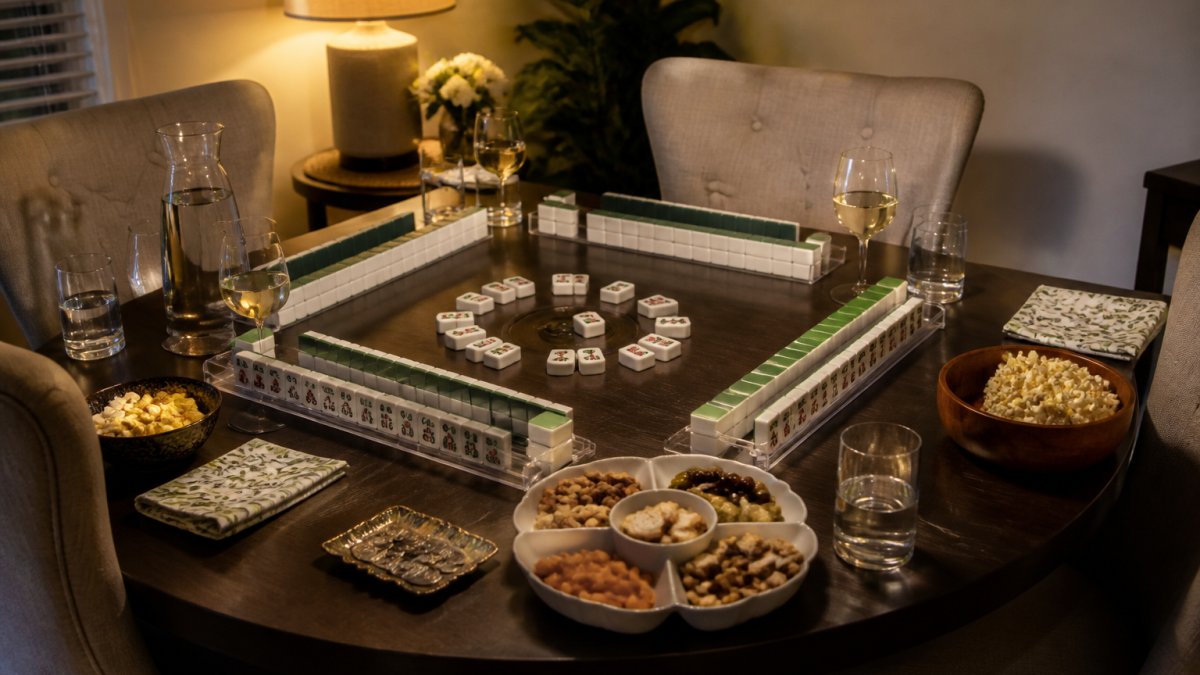
Snacks should be easy to eat without greasy hands: cheese, crackers, nuts, and fruit. Avoid chocolate and anything that stains.
For personality, try mahjong-themed napkins or a tile-patterned tablecloth. The Mahjong Club Weekly Planner from AmericaMahjongfun.com includes printable organizers for tracking games.

| Element | Purpose | Example |
|---|---|---|
| Lighting | Comfort and visibility | Table lamp, soft overhead light |
| Music | Ambiance | Instrumental, jazz, low volume |
| Snacks | Easy eating | Cheese, nuts, fruit, crackers |
| Drinks | Hydration and enjoyment | Water, wine, tea, coffee |
| Decor | Personality | Mahjong-themed napkins, table runner |
Hosting a mahjong night for beginners is simpler than you think.
Our printable party game bundles and organizers take the stress out of planning.
Frequently Asked Questions
What do I need to host a mahjong night for beginners?
You'll need at least one complete mahjong set (144 tiles), four tile racks, a rules card or reference guide, and a comfortable table for four players. For multiple tables, add extra sets and racks. A mahjong money dish (like the one from AmericaMahjongfun.com at $22.99) adds a nice touch for tracking game points. Have printed beginner reference cards available so players can check hand rankings without interrupting the game.
How do I teach mahjong to beginners at a party?
Start by explaining the goal: form winning hands using tiles. Show the basic hand rankings before playing. Run a practice round where everyone plays openly so beginners can see how tiles move and how turns work. Keep a rules card visible throughout the game and pause to clarify calling a tile or discarding. Let experienced players sit with beginners at the same table. Most beginners grasp the basics after one practice round and one real game.
How long should a beginner mahjong night last?
Plan for 3 hours total. Spend the first 30 minutes on setup, introductions, and teaching the rules. Allow 2 to 2.5 hours for actual gameplay (about 4-6 hands depending on player speed). Beginners play slower than experienced players, so expect hands to take 15-20 minutes each. Include a 15-minute break halfway through for snacks and drinks. This length keeps energy high without overwhelming newcomers.
What snacks and drinks should I serve at a mahjong night?
Serve light appetizers and refreshments that don't require two hands to eat or drink. Good options include cheese and crackers, nuts, fruit, cookies, and vegetable platters. Offer water, tea, coffee, and optional wine or beer. Avoid sticky snacks that could damage tiles. Set drinks in cups with lids to prevent spills near the game table. Small bites keep players comfortable during a 2-3 hour gathering without creating mess or distraction.