
Table of Contents
- Step 1: Choose Your Tournament Format and Structure
- Step 2: Establish Mahjong Tournament Rules and Regulations
- Step 3: Plan Venue, Equipment, and Logistics
- Step 4: How to Manage Mahjong Tournament Rotations
- Step 5: Design Your Mahjong Tournament Scoring Sheets
- Step 6: Register Players and Manage Entry Fees
- Step 7: Use Mahjong Party Games Digital Downloads for Breaks
- Step 8: Create Your Tournament Schedule and Timeline
- Frequently Asked Questions
Last Updated: October 2, 2026
Step 1: Choose Your Tournament Format and Structure
Learning how to organize a mahjong tournament step by step begins with choosing your format: round-robin or elimination. This choice shapes registration numbers, venue size, timeline, and player experience.
Round-Robin vs. Elimination Formats
A round-robin tournament lets every player compete against multiple opponents, accumulating points throughout the event. This format works best for clubs with 12-32 players and emphasizes participation over competition.
Elimination tournaments move players forward based on performance; losers drop out, winners advance. This format compresses the timeline and works well for larger groups or when you want a clear champion quickly.
In round-robin, seeding determines initial table assignments. In elimination, seeding determines bracket placement. Pick the format that matches your club's culture and goals.
Seeding and Player Advancement
Seeding ranks players before the tournament starts, typically based on prior club rankings or win-loss records. Strong seeding prevents top players from facing each other too early.
For round-robin, spread strongest players across different starting tables. For elimination, the top seed faces the lowest-ranked opponent in the first round.
In elimination, winners move up and losers exit. In round-robin, advancement is measured by cumulative score. Communicate advancement rules to all participants before play starts.
Step 2: Establish Mahjong Tournament Rules and Regulations
Before the first hand is dealt, you need an official ruleset and a plan for disputes. Vague rules create conflict; clear rules create trust.
Official Ruleset and House Rules
The National Mah Jongg League (NMJL) publishes the official American Mahjong ruleset, which most clubs follow. Using the official ruleset means players know what to expect and can reference a published standard if questions arise.
Many clubs add house rules, local variations that reflect their group's preferences. Document these in writing and distribute them to all players at least one week before the tournament.
Post both the official ruleset and house rules on a visible board during play so players can reference them without stopping the game.
Tie-Breaking Procedures and Arbitration
Your tournament director needs a clear tie-breaking procedure before the first hand is played.
Common tie-breakers include head-to-head results, point differential, or playoff hands. Choose one method and stick with it.
Designate your tournament director as the final authority on rule disputes. They should make a decision quickly and move play forward. Make it clear that the director's decision is final and binding.
Step 3: Plan Venue, Equipment, and Logistics
The physical space where your tournament happens shapes the entire experience. A cramped, poorly lit room with inadequate tables frustrates players. A well-organized venue with proper equipment runs smoothly and keeps everyone focused on the game.
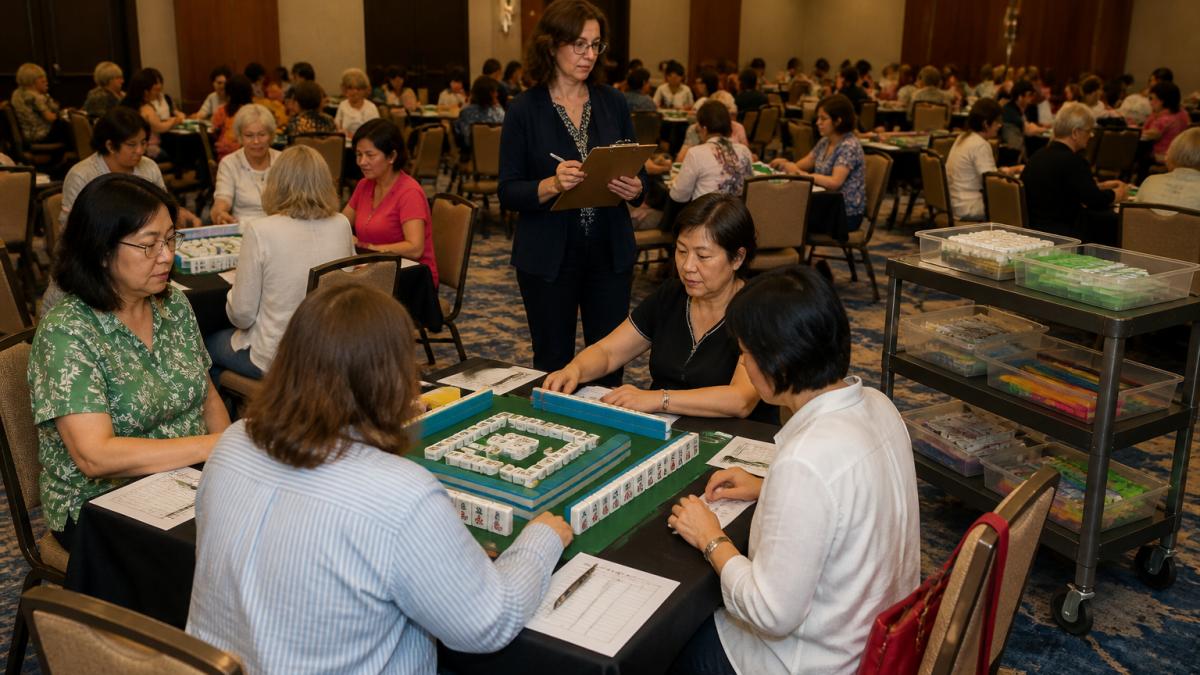
Venue Capacity and Table Setup
A standard mahjong table seats four players. Divide your player count by four to determine the number of tables needed.
Reserve a venue with at least 3 feet of space between tables. A 20-table tournament requires roughly 1,500-2,000 square feet. Churches, community centers, and hotel conference rooms work well.
Ensure good lighting without harsh shadows or glare. Aim for 68-72 degrees Fahrenheit.
Essential Equipment and Supplies
Each table needs a complete American Mahjong set, a timer, and scoring sheets. Bring extras of everything.
Scoring sheets are the official record of each hand. Print them clearly and in sufficient quantity, with at least 20% extra.
Bring a whiteboard for posting results, a bell to signal round starts and ends, and a registration table. Provide comfortable chairs; players sit for hours.
Step 4: How to Manage Mahjong Tournament Rotations
How to manage mahjong tournament rotations is the logistical heart of your event. Players must move to different tables and different opponents in each round so that everyone plays against everyone else (in a round-robin) or advances fairly (in an elimination bracket).
Seat Rotation and Table Rotation Policies
In round-robin, both tables and seats rotate. After each round, players move to a new table and sit in a different position (East, South, West, North). This ensures every player faces every other player.
A common rotation method: players move up one table after each round. Within each table, rotate seats clockwise after each hand.
For elimination tournaments, rotate seats within matches so no player sits in the same position for every hand.
Tracking Player Movement
Create a rotation chart showing where each player sits in each round, including table numbers and seat positions. Distribute a copy to each player.
Assign someone to monitor rotations and check that players move to the correct table and seat. This prevents confusion and keeps the tournament on schedule.
Step 5: Design Your Mahjong Tournament Scoring Sheets
Your mahjong tournament scoring sheets are the official record of every hand and every player's final ranking. They must be clear, complete, and accurate.
Hand Tallying and Score Verification
A scoring sheet records the score for each hand, listing the winning player, point value, and who paid out points. Add up points at the end of the round for each player's total.
Accuracy is critical. After each round, verify every sheet for correct math, consistent player names, and no missing scores.
Use clear, large handwriting and avoid abbreviations. Consistency prevents mix-ups when tallying final scores.
Penalty Points and Final Rankings
Penalty points apply when a player breaks a rule. Common penalties range from 5 to 25 points deducted from the player's score.
Record penalties on the scoring sheet immediately and clearly. Note the violation and the penalty points applied.
Step 6: Register Players and Manage Entry Fees
Registration is your first touch point with participants. A smooth registration process sets the tone for the whole event.
Participant Registration Process
Create a registration form that collects each player's name, contact information (phone and email), and any relevant background (club affiliation, prior tournament experience, or dietary restrictions if you're providing food). Ask for the information you actually need, don't bloat the form with questions you won't use.
Entry Fee Collection and Prize Pool Distribution
Entry fees cover venue rental, supplies, and prizes. A typical entry fee ranges from $10 to $25 per player, depending on prize payouts and venue costs. Collect fees at registration, either in person or via online payment.
Step 7: Use Mahjong Party Games Digital Downloads for Breaks
Between rounds, players need a break from competitive play. This is where AmericaMahjongfun.com's party game bundles shine. Digital downloads like the Halloween Mahjong Party Games Printable Bundle provide instant entertainment without setup hassle.

Step 8: Create Your Tournament Schedule and Timeline
Understanding how to organize a mahjong tournament step by step includes creating a clear schedule that keeps the tournament moving and helps players plan their day.
Match Duration and Game Flow
A typical mahjong hand takes 15-20 minutes, depending on player skill and house rules. A round of four hands takes 60-80 minutes. Build your schedule around these estimates, adding 10 minutes between rounds for player movement and restroom breaks.
Scheduling Rounds and Breaks
Publish a detailed schedule showing the start time of each round, which players are at which tables, and when breaks occur. Distribute this schedule to all players at least one week in advance. Include a note about what time to arrive for check-in.
Frequently Asked Questions
What is the standard format for a mahjong tournament?
The two most common formats are round-robin and elimination. Round-robin has every player compete against each other across multiple rounds, producing the most accurate rankings. Elimination brackets move winners forward and remove losers. Round-robin works best for smaller groups under 20 players; larger tournaments often use a combination where round-robin determines seeding, then elimination determines final placement on the final table.
How do you calculate scores in a mahjong tournament?
Most American Mahjong tournaments use hand-by-hand scoring where each winning hand earns points based on the tiles involved. Players track cumulative scores across all rounds. Some tournaments use payment-based scoring where players settle money for each hand. Using mahjong tournament scoring sheets ensures accurate hand tallying and prevents disputes. Verify your official ruleset before play begins, as house rules vary by club.
What supplies are needed to host a mahjong tournament?
Essential supplies include mahjong sets (one per table), scorecards and pencils, a timer for match duration, a tournament bracket or seeding chart, volunteer badges, and a registration list. Consider adding mahjong party games digital downloads for entertainment during breaks, they keep players engaged and add festive energy to your event. The Mahjong Club Weekly Planner helps you track player information, schedules, and hosting duties throughout your tournament.
How do you manage player rotations at a mahjong tournament?
Seat rotation and table rotation keep play fair and prevent collusion. Most tournaments rotate players to new tables after each round, changing both their table and seat position. Create a rotation schedule before play starts and post it clearly so players know where to sit next. Track player movement on a bracket to prevent duplicate pairings. Digital tournament management software can automate this, but a simple spreadsheet works for smaller events under 30 players.