
Table of Contents
- Mahjong vs Rummikub at a Glance
- How Mahjong and Rummikub Differ in Core Gameplay
- Mahjong Rules for Beginners
- Rummikub Rules for Beginners
- Strategy, Complexity, and Learning Curve
- Mahjong Game Night Ideas and Setup
- Rummikub Game Night: Group Size, Pace, and Social Fit
- Which Game Should You Choose?
- Frequently Asked Questions
Last Updated: October 11, 2026
Mahjong vs Rummikub at a Glance
When deciding between mahjong vs rummikub for game night, it comes down to what your group enjoys most. Both are tile-based games that reward strategy and attention, but they play very differently. Mahjong uses a larger tile set with Chinese symbols and suits, while rummikub uses numbered tiles that feel more familiar to card game players.
Here's what separates them at first glance: mahjong takes longer to learn and demands more memory work, but rummikub plays faster and feels more intuitive if you've played card games before. Mahjong suits players who want deep strategy and a slower social pace. Rummikub works better for groups that want quick rounds and lighter competition.
The choice matters because picking the wrong game means frustrated players and abandoned game nights. We'll walk you through both games so you can match the right one to your group's style, skill level, and available time.
How Mahjong and Rummikub Differ in Core Gameplay
Mahjong and rummikub share one thing: both use tiles instead of cards. Beyond that, the games diverge sharply. Mahjong is fundamentally about collecting matching sets of tiles before your opponents do. Rummikub is about laying numbered sequences and groups on the table in a specific order.
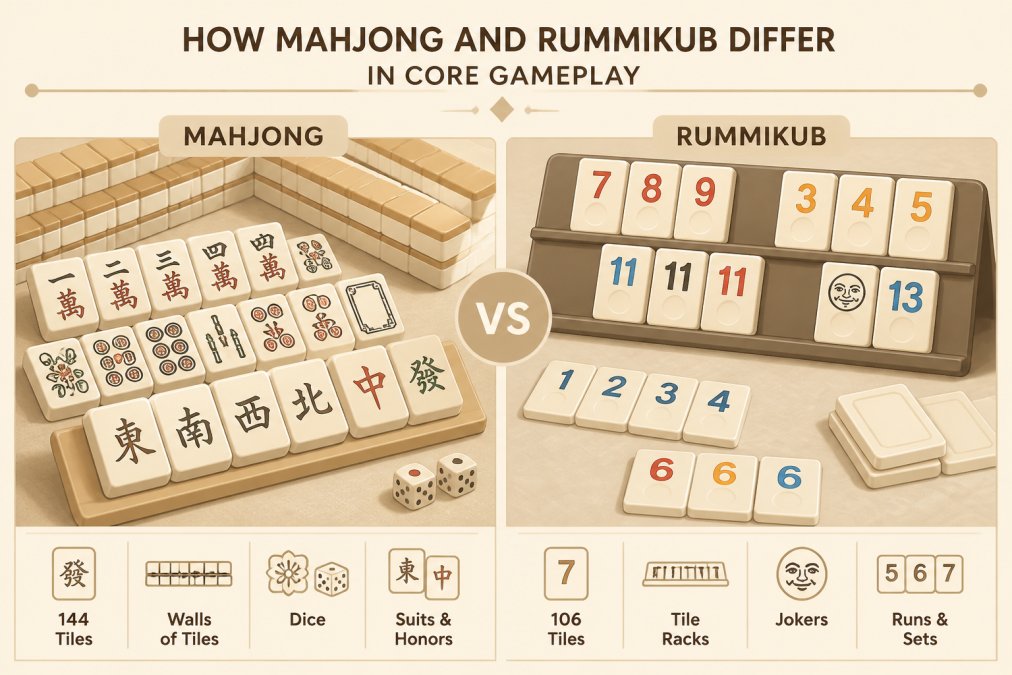
The pace tells you everything. Mahjong rounds stretch 30 to 45 minutes for experienced players. Rummikub rounds finish in 20 to 30 minutes. If your group has limited time, rummikub wins. If everyone's settled in for the evening, mahjong delivers the deeper experience.
Tiles, Numbers, Suits, and Sets
Mahjong uses 144 tiles organized into suits: bamboo, characters, and dots, plus honors and bonus tiles. Each suit runs from 1 to 9. The visual complexity is real. You're learning not just numbers but symbols. New players often feel overwhelmed by the tile faces.
Rummikub strips this down. You get numbered tiles from 1 to 13 in four colors: red, yellow, blue, and black. Two jokers act as wild tiles. If you've played card games, the numbering system feels natural. The tiles sit on a rack in front of you, and you can see everything you need at a glance.
This difference shapes the entire game. Mahjong players spend mental energy remembering which tiles are in play. Rummikub players focus on strategy because the tiles are visible and organized. For beginners, rummikub's simplicity wins. For players who enjoy memory challenges, mahjong delivers that satisfaction.
Runs and Melds
In mahjong, you build melds. A meld is three or four tiles of the same suit in sequence (like 1-2-3 of bamboo) or three or four identical tiles (like three 5-dots). The goal is to complete a hand of melds plus a pair. It sounds simple. The execution demands pattern recognition and planning ahead.
Rummikub uses runs and groups. A run is three or more consecutive numbered tiles in the same color (like 5-6-7 in red). A group is three or four tiles of the same number in different colors (like three 8s). You lay these on the table as you form them.
The key difference: mahjong melds stay hidden in your hand until you win. Rummikub runs and groups go on the table immediately. This makes rummikub more interactive and visible. Everyone sees what everyone else is building. Mahjong keeps more mystery alive.
Turn Structure and Drawing
Mahjong turns follow a strict rhythm. You draw one tile, examine your hand, and discard one tile. That's it. The simplicity masks the decision-making. Which tile do you throw away? That choice ripples through the game. Discarding the wrong tile gives opponents exactly what they need to win.
Rummikub turns are more flexible. You draw one tile if you can't play. If you can play tiles from your hand, you lay them down immediately. Once you've played, you can rearrange the table's tiles to create new combinations. This means your turn might involve moving tiles around the table, not just laying down your own. The game feels more collaborative because the table state changes constantly.
For newer players, mahjong's rigid turn structure is easier to follow. Rummikub's flexibility rewards creative thinking but can confuse beginners about what moves are legal.
Mahjong Rules for Beginners
Mahjong rules for beginners start simple but layer in complexity fast. The core rule is this: build a winning hand of four melds plus one pair before anyone else does. You draw tiles, build combinations, and discard tiles you don't need.
The learning curve comes from understanding which combinations count as valid melds and which discard choices hurt you. American mahjong adds a card that shows legal hands for that round, which simplifies things. You're not memorizing 81 possible winning patterns.
Setup takes 10 minutes for new players. Shuffling 144 tiles, building walls, and distributing tiles feels ceremonial. That's part of the charm. Each player starts with 13 tiles. The game moves clockwise. Turns are fast once everyone understands the rhythm.
The biggest hurdle for beginners is remembering which tiles are in play. Mahjong players track discarded tiles mentally. This memory work separates casual players from serious ones. If memory games frustrate your group, mahjong will too.
Rummikub Rules for Beginners
Rummikub rules for beginners are straightforward. Draw a tile. Play tiles if you can. Lay down a run or group when you're ready. That's the entry point. The rules fit on one page.
The first round is your hardest. You must lay down a set worth at least 30 points before you can play other tiles.
Setup takes three minutes. Shuffle the tiles, place them face-down in the center, and give each player a rack. Everyone draws tiles and organizes their rack. You're ready to play in five minutes flat.
The game feels intuitive if you've played Gin Rummy or any card game with melds. The numbered tiles read like a simplified card deck. New players grasp the rules in one round.
Rummikub's flexibility is its strength for beginners. You can rearrange the table to try different combinations. If a move doesn't work, you undo it. This trial-and-error approach builds confidence. Mahjong doesn't offer that freedom.
Strategy, Complexity, and Learning Curve
Mahjong strategy demands forward planning and memory. You're tracking which tiles your opponents discarded, which tiles are likely still in the wall, and which combinations they're building. Experienced players remember every discard.
The learning curve for mahjong is steep. Beginners need five to ten games to feel comfortable. Twenty games in, you're starting to recognize patterns. After fifty games, you're thinking two moves ahead.
Rummikub strategy is about flexibility and tile management. You're deciding when to play your tiles versus holding them for a bigger move. You're spotting opportunities to rearrange the table and create space.
Rummikub's learning curve is gentle. Most players feel competent after two or three games. The rules stay simple. The strategy deepens naturally through play.
For competitive players, mahjong offers more intellectual challenge. For social players who want to focus on conversation, rummikub wins. It's the difference between chess and checkers. Both reward skill, but one demands more from your brain.
Mahjong Game Night Ideas and Setup
Mahjong game nights work best with four players. The game supports two to four, but four is the sweet spot. Everyone stays engaged. No one sits idle waiting for their turn.
Setup for mahjong takes patience. You'll need a mahjong set (144 tiles), a table with enough space, and racks for each player. Shuffle the tiles face-down. Build the wall. Distribute tiles.
The social rhythm of mahjong is slower and more meditative. Players sit quietly, studying their tiles. Conversation happens between hands, not during them.
Hosting mahjong nights works well with themed snacks and drinks. Keep them light so players don't get crumbs on the tiles. Clubs often pair mahjong with tea service or light appetizers.
Round length matters for planning. Budget 45 minutes per game for experienced players, 60 minutes for newer ones. A four-hour game night fits four to five games. Build in breaks between rounds so players can stretch and refocus.
Rummikub Game Night: Group Size, Pace, and Social Fit
Rummikub game nights work with two to four players, but the game shines with three or four. Two-player games feel thin. Four players create enough competition and unpredictability to stay interesting.
Setup is quick. Shuffle tiles, distribute racks, and you're playing in five minutes. This speed matters for game nights. You can start playing while people are still arriving.
The social rhythm of rummikub is faster and more interactive. Players talk during their turns. Laughter happens. The table feels alive. If your group wants conversation and energy, rummikub delivers.
Rummikub rounds finish in 20 to 30 minutes. A four-hour game night fits eight to ten games. You can play multiple rounds back-to-back without fatigue. The game never demands the mental intensity that mahjong does.
Hosting rummikub nights is flexible. You can play while eating, since the tiles sit on racks and don't scatter. Keep snacks within arm's reach. The game tolerates casual play better than mahjong.
Which Game Should You Choose?
Pick mahjong if your group wants depth, memory challenge, and a slower social pace. Mahjong suits experienced game players and club members who've played together for years.
Pick rummikub if your group wants quick rounds, easy rules, and interactive play. Rummikub suits mixed-skill groups and casual game nights.
Consider your available time. Mahjong demands 45 to 60 minutes per round. Rummikub finishes in 20 to 30 minutes. If you have limited time, rummikub fits better.
Consider your group's patience for learning. Mahjong requires 10 to 20 games to feel natural. Rummikub clicks after two or three games.
Consider your table space. Mahjong needs room for the wall, tiles, and racks. Rummikub is compact. Mahjong creates a more formal game night. Rummikub feels casual.
Both games build community. Both reward skill and attention. The difference is tone. Mahjong is meditative and strategic. Rummikub is energetic and tactical. Choose the tone that fits your group.
Choosing the right tile game for your group isn't just about rules, it's about creating the experience you actually want. If you're hosting a mahjong night, AmericaMahjongfun.com offers printable party game bundles and themed organizers that make setup effortless and keep scorecards organized throughout the evening.
| Aspect | Mahjong | Rummikub |
|---|---|---|
| Tiles Used | 144 tiles with suits and symbols | 106 tiles numbered 1-13 in four colors |
| Round Length | 45-60 minutes | 20-30 minutes |
| Best Player Count | 4 players | 3-4 players |
| Learning Curve | Steep (10-20 games) | Gentle (2-3 games) |
| Setup Time | 10-15 minutes | 3-5 minutes |
| Memory Demands | High (tracking discards) | Low (tiles visible) |
| Social Pace | Meditative, quiet | Energetic, interactive |
| Best For | Strategy lovers, clubs | Casual groups, mixed skills |
| Aspect | Mahjong | Rummikub |
|---|---|---|
| Complexity | High | Low |
| Strategy Depth | Deep, forward planning | Tactical, puzzle-solving |
| Interaction | Indirect (discard watching) | Direct (table rearrangement) |
| Luck Factor | Moderate | Moderate |
| Accessibility | Challenging for beginners | Welcoming for beginners |
| Game Night Vibe | Formal, focused | Casual, social |
Frequently Asked Questions
Which is easier to learn, mahjong or Rummikub?
Rummikub is typically easier for beginners because the rules are more straightforward: match numbers and colors or build sequences. Mahjong has a steeper learning curve due to its tile combinations, wind and dragon tiles, and the concept of winning hands. Most players grasp basic Rummikub gameplay in one session, while mahjong often requires several games to feel comfortable.
How long does a game of mahjong or Rummikub take?
A typical Rummikub game lasts 30 to 60 minutes, depending on player experience and group size. Mahjong games vary more widely: casual American Mahjong rounds take 45 minutes to 90 minutes, while faster-paced games may finish in 30 minutes. Both games can extend longer with experienced, competitive players who take time to think through strategy.
How many players can play mahjong and Rummikub?
Mahjong is designed for exactly four players, though some regional variations allow three players. Rummikub accommodates two to four players, making it more flexible for smaller or larger groups. If you have an odd number of people at game night, Rummikub works better, or you can rotate players in and out of mahjong rounds.
What supplies do you need to host a mahjong or Rummikub game night?
For mahjong, you need a tile set (144 tiles for American Mahjong), a rack for each player, a scorecard, and a reference card showing winning hand combinations. For Rummikub, you need one or two tile sets (depending on player count), racks for each player, and a scorecard. Both games benefit from a stable playing surface and good lighting. Digital organizers and printable scorecards can simplify tracking during the evening.