
Table of Contents
- Why Mahjong Cards Need Different Paper Than Greeting Cards
- The 7 Paper Types for Printing Mahjong Cards Compared
- How to Choose Paper Weight for Printable Cards
- Matte vs. Glossy Cardstock: Which Finish Reads Better
- Best Paper for Printing Playing Cards That Hold Up
- Home Printer Cardstock Settings That Prevent Jams
- Lamination and Finishing for Longer-Lasting Cards
- Conclusion
- Frequently Asked Questions
Last Updated: October 17, 2026
Why Mahjong Cards Need Different Paper Than Greeting Cards
Mahjong cards take more abuse than a birthday card ever will. A greeting card gets opened once and propped on a shelf.
The second problem is legibility. Mahjong cards carry small symbols, suit markers, and numbers that players read at arm's length under club lighting.
So the paper question isn't cosmetic: it decides how the cards feel, how long they last, and whether players can actually read them.
The 7 Paper Types for Printing Mahjong Cards Compared
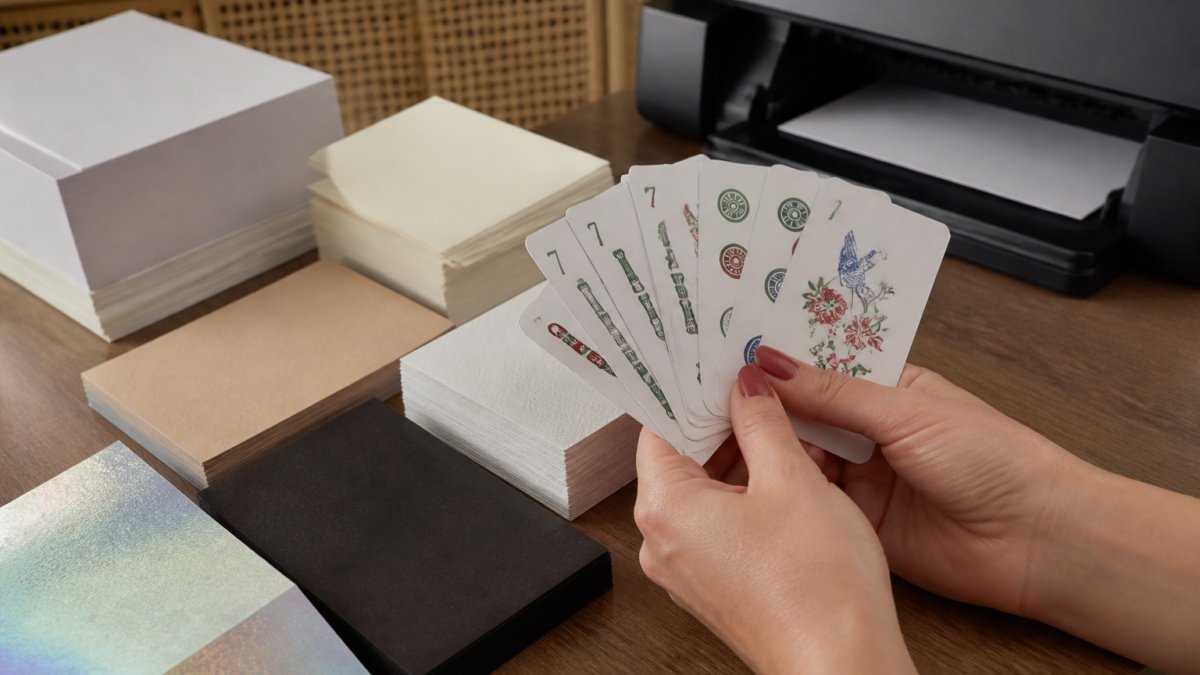
Seven paper families cover almost every home-printing need. The table below ranks them for mahjong use, then each entry explains how the stock behaves when shuffled, fanned, and read at arm's length.
| Rank | Paper Type | Typical Weight | Finish | Best Mahjong Use | Main Drawback |
|---|---|---|---|---|---|
| 1 | 300 gsm cover stock | 300 gsm | Smooth matte | Durable club play sets | Needs a printer rated for heavy stock |
| 2 | 110 lb cardstock | ~300 gsm | Matte or lightly textured | Everyday club and teaching sets | Edges soften with heavy shuffling |
| 3 | Silk-finish cardstock | 250-400 gsm | Soft satin | Comfortable repeated handling | Less common in stores |
| 4 | Adhesive paper + backer board | Varies | Depends on facing sheet | Rigid tile-like cards and gifts | More assembly time |
| 5 | Matte photo paper | Varies | Flat matte | Sharp symbol clarity as a facing layer | Thin and floppy alone |
| 6 | Glossy photo paper | Varies | High shine | Vivid color art on display cards | Glare under club lights |
| 7 | Kraft paper | Light | Natural, porous | Prototypes and rustic designs | Weak ink hold, brown base |
1. 300 gsm Cover Stock
Cover stock is the top pick for mahjong cards that will be shuffled and dealt repeatedly. At 300 gsm it holds a crease, resists dog-earing, and has enough snap to slide cleanly across a table; a floppy sheet buckles at the corner and wears first. The catch is printer compatibility: check your printer's rated maximum weight before buying, and feed sheets one at a time through a rear or manual tray if your model has one.
2. 110 lb Cardstock
110 lb cardstock is the practical baseline for home-printed mahjong sets. It is stiff enough to fan and deal, cheap enough to reprint a whole set when a design changes, and widely available in matte and lightly textured finishes. At roughly 300 gsm it sits near the upper edge of what a typical inkjet feed path handles, so test one sheet before committing to a bulk order.
3. Silk-Finish Cardstock
Silk finish, sometimes sold as satin, sits between matte and gloss. It has a faint sheen that resists fingerprints and a soft texture that feels comfortable sliding across a table, and the low sheen keeps glare manageable under overhead club lighting. Availability is the weak point: silk cardstock is less common on store shelves, so you may need to order online and wait.
4. Adhesive Paper on Backer Board
This is the DIY route to a genuinely rigid card. Print on adhesive paper, then mount it to a thin backer board or matte board cut to size. The result handles like a thin tile and survives aggressive shuffling, making it the best option for a gift set or tournament-grade deck. The cost is time: every card needs trimming and mounting, and a full set can take an evening.
5. Matte Photo Paper
Matte photo paper wins on print quality. Its smooth surface holds fine detail, so tiny suit symbols and numbers stay crisp instead of bleeding. The trade-off is body: photo paper is thin and floppy next to cardstock. Use it as a facing layer glued to a heavier backer, or accept a lighter card better suited to scorekeeping sheets and reference cards than a full playing set.
6. Glossy Photo Paper
Glossy photo paper makes color pop, which matters if your mahjong cards use bold retro art or metallic-style accents. The problem is practical: gloss reflects overhead lighting, and a table full of shiny cards becomes a glare field, with older players losing symbol contrast fast. Gloss works for display pieces, box lids, and gift cards; matte or silk is the safer bet for actual play.
7. Kraft Paper
Kraft paper is the prototype material. It is inexpensive, easy to source, and its natural brown tone suits rustic or vintage designs. It also fights you on color: the brown base shifts every printed hue, and its porous surface drinks ink unevenly. Use kraft for draft layouts and proof-of-concept cards, not the final set, though it works for disposable score sheets where legibility matters more than longevity.
How to Choose Paper Weight for Printable Cards
Paper weight for printable cards comes down to one question: how hard will these cards be used? Match the weight to the job, not the thickest sheet you can find.
- Light handling (score sheets, reference cards): 65-80 lb cover is plenty.
- Regular club play: 110 lb cardstock is the practical baseline.
- Heavy shuffling and long-term use: 300 gsm cover stock or an adhesive-mounted card.
- Gift or keepsake sets: silk-finish or mounted cards justify the extra effort.
Weight also has a hard ceiling set by your printer. Most home inkjets list a maximum paper weight in the manual, and exceeding it causes misfeeds and smearing.
Matte vs. Glossy Cardstock: Which Finish Reads Better
Matte wins for mahjong cards, and it's not close. Matte surfaces scatter light instead of bouncing it, so symbols stay readable from any angle and under any lamp.
There's a second reason matte reads better: ink behavior. On matte stock, ink settles into the surface and dries with clean edges; on gloss, ink sits on top of the coating and can smear if you handle cards too soon.
Best Paper for Printing Playing Cards That Hold Up
The best paper for printing playing cards balances stiffness, snap, and surface durability. In practice, that means 300 gsm cover stock for most home setups, or adhesive paper mounted to backer board when you want real rigidity.
Durability comes from three things: weight, finish, and edge treatment.
A common mistake is printing on both sides without checking registration. Double-sided printing on heavy stock often shifts slightly, so the back pattern sits off-center.
Home Printer Cardstock Settings That Prevent Jams
Home printer cardstock settings matter more than most people expect. The right settings prevent jams, smearing, and misfeeds; the wrong ones turn expensive cardstock into scrap. For mahjong cards, the setup also decides whether double-sided faces line up and whether ink dries before handling.
- Set paper type to "cardstock" or "heavy" in the print dialog, not "plain paper." This slows the feed and adjusts ink volume so heavy sheets do not smear.
- Choose the rear or manual feed tray if your printer has one. It takes a straighter path and handles thick sheets better than a bottom cassette.
- Load one sheet at a time for anything above 110 lb. Multi-sheet stacks are the leading cause of jams on heavy stock.
- Select "best" or "high quality" print mode so ink lays down evenly and dries properly.
Check Your Printer's Rated Maximum Weight First
Before buying any stock, find your printer's maximum paper weight in the manual or the manufacturer's specifications. Most home inkjets list a maximum in pounds or gsm, and exceeding it causes misfeeds, smearing, and roller wear. If your printer is rated for light cardstock only, choose 110 lb cardstock or a lighter cover stock rather than forcing 300 gsm through it.
Double-Sided Printing and Registration
Mahjong cards often need a printed face and a patterned or labeled back. Double-sided printing on heavy stock frequently shifts slightly, so the back pattern sits off-center. Print a two-sided test page, hold it to a light, and adjust your printer's alignment before running the full set. If your printer lacks automatic duplexing for heavy stock, print one side, let it dry, then re-feed the sheets manually using the alignment marks on the tray.
Ink Drying and Handling
Ink behavior depends on the stock. On matte and uncoated cardstock, ink settles into the surface and dries with clean edges; on coated or glossy stock, ink sits on top and can smear if you handle cards too soon. Give coated sheets extra drying time, avoid stacking freshly printed cards until the ink is fully set, and use a small desk fan on low speed to speed drying without blowing dust onto the wet surface.
When Your Printer Cannot Handle the Stock
If jams persist after adjusting settings, your printer likely is not rated for that weight. Step down a grade rather than forcing it. For rigid, tile-like cards, the adhesive-paper-and-backer method lets you print on a lighter facing sheet and mount it to board afterward, keeping the printer within its limits while still producing a durable card.
Lamination and Finishing for Longer-Lasting Cards
Lamination is the cheapest way to extend card life, and it solves two problems at once.
Finishing goes beyond lamination. A corner rounder softens sharp edges and prevents fraying, and a paper trimmer gives cleaner cuts than scissors when every card needs identical dimensions.
For printable mahjong score sheets and reference cards, lamination means you can reuse them with dry-erase markers.
Conclusion
Choosing paper for mahjong cards is a series of trade-offs between weight, finish, printer limits, and how hard the cards will be used.
At AmericaMahjongfun.com, we design printable American Mahjong greeting cards, party game bundles, and organizational tools built to print cleanly on standard home equipment. Our instant digital downloads mean you can pick a design, print it the same day, and bring something festive to your next club meeting.
Frequently Asked Questions
What paper weight works best for printable mahjong cards?
Aim for 250-400 gsm, which translates to roughly 90-110 lb cover stock in pound weight. That range gives mahjong cards enough stiffness to stand in a rack and survive repeated shuffling without creasing. Anything lighter than 200 gsm feels flimsy and bends at the corners after a few games. Anything much heavier than 400 gsm may jam a home printer. If your printer is rated for heavy stock, 300 gsm is the sweet spot for most American Mahjong card sets.
Should mahjong cards be printed on matte or glossy paper?
Matte usually wins for mahjong cards because it cuts glare under club lighting and keeps small suit symbols legible for older players. Glossy cardstock produces sharper color and a more premium feel, but reflections can wash out fine print. A silk finish sits between the two: low sheen, smooth surface, good ink hold. Test one sheet of each with your actual card design before committing to a full pack.
Can you print game cards on a home printer?
Yes, if you match the paper to the printer. Inkjet models handle matte and silk cardstock well up to about 300 gsm, while laser printers need stock explicitly rated for laser use to avoid toner flaking or heat damage. Set the paper type to cardstock or heavy in the print dialog, feed sheets one at a time through the rear tray, and let prints dry fully before handling. Double-sided printing works but requires a manual flip on most home machines.
Do printed mahjong cards need lamination?
Lamination is optional but adds real durability. A 3-5 mil pouch or self-adhesive sheet protects the printed surface from oils, spills, and edge wear, and it stiffens thin cardstock so it handles more like a real tile. The trade-off is bulk and a slight sheen. For cards used weekly at club, laminate. For one-off party games or prototypes, a matte spray sealer is enough to stop ink smudging.