
Table of Contents
- Understanding the NMJL Card and Hand Selection
- The Easiest Hands to Win in American Mahjong
- How to Read a Mahjong Card for Hand Probability
- Best Strategy for American Mahjong Hand Selection
- Hand Difficulty Tiers and What to Avoid
- Celebrate Your Winning Hand
- Frequently Asked Questions
Last Updated: September 28, 2026
Understanding the NMJL Card and Hand Selection
The NMJL card shows every possible winning combination for the year, organized by hand type and difficulty. It lists hands from easiest to hardest, displaying the tiles you need and which melds form the winning pattern. Understanding the card's structure helps you instantly spot which hands are within reach.
Focus on understanding hand categories, consecutive runs, like numbers, 2468 hands, and special patterns, rather than memorizing every hand. Each category has its own logic and probability.
The Easiest Hands to Win in American Mahjong
The easiest hands use tiles from multiple suits, don't require rare honors, and can be completed from several different tile combinations. Prioritizing these hands increases your winning frequency significantly.
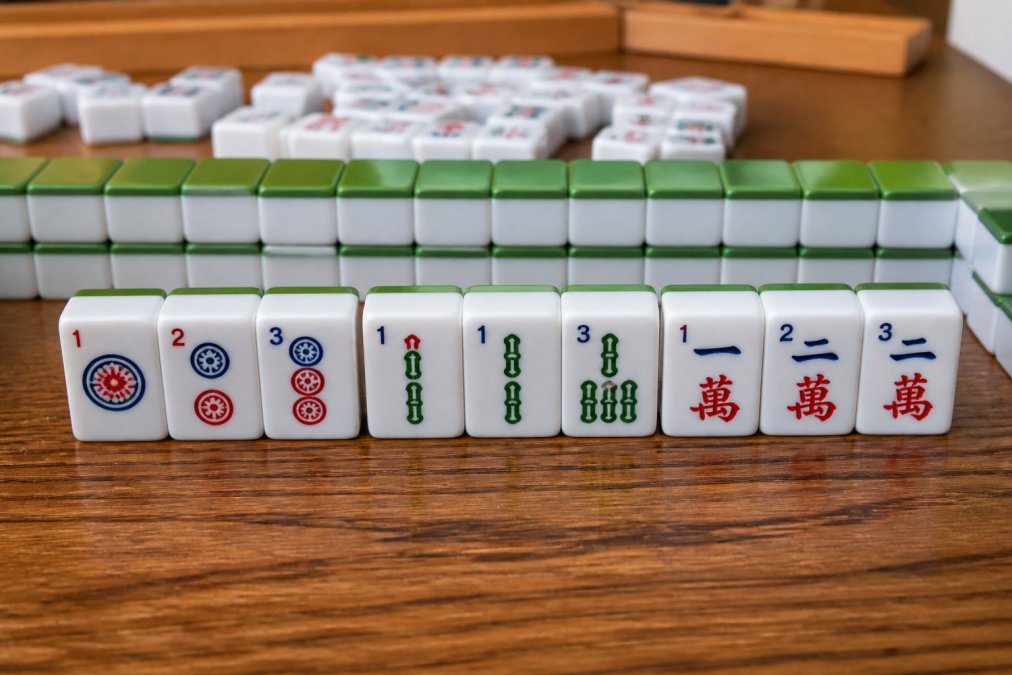
Consecutive Run Hands
Consecutive run hands use tiles in numerical sequence (1-2-3, 4-5-6, 7-8-9) and require four melds of three tiles plus a pair. Their flexibility, you can build from any suit with multiple completion paths, makes them ideal for beginners. Drawing three consecutive numbers happens regularly, and you don't need rare tiles.
Like Numbers Hands
Like numbers hands require all tiles with the same number across different suits (e.g., all 5s). Once you identify your target number, you simply track which suits you need. The simplicity, pursuing one clear target across three suits, helps you make faster decisions than juggling multiple sequences.
2468 Hands for Beginners
2468 hands use only tiles numbered 2, 4, 6, and 8, reducing complexity significantly. You track fewer tile combinations and spot winning opportunities faster than players pursuing all nine numbers. When you focus exclusively on these four numbers, you'll complete a 2468 hand regularly.
How to Read a Mahjong Card for Hand Probability
A hand's probability depends on how many tiles you need, how many exist in the deck, and how many opponents compete for them, not just the hand's complexity.
Counting Tile Frequency
Each numbered tile appears in three suits with four copies in the deck. A consecutive run hand using nine different tile values has 36 helpful tiles, while a like numbers hand using three tile values has only 12, giving the consecutive run hand three times more tiles working in your favor.
Hands requiring honors face different probability curves. The deck contains four copies of each wind and three of each dragon. Hands requiring all four winds need 16 specific tiles; hands requiring all three dragons need nine. Both are rarer than numbered-tile hands.
Identifying Hand Variations and Multiple Paths
Count the patterns listed for each hand on the card. Hands with two or three patterns are significantly easier than hands with only one, this distinction matters more than the hand's position on the card.
The Discard Psychology Factor
The easiest hand to win is often the one opponents are actively discarding tiles for. Watch the discard pile before committing to a hand. A hand that looks difficult on paper becomes easy when opponents discard the tiles you need. Conversely, hands that appear easiest on the card (consecutive runs, like numbers) are often harder in actual play because multiple opponents pursue them simultaneously.
Best Strategy for American Mahjong Hand Selection
Identify which hands align with your current tiles and pursue them with discipline.
Choosing Your Starting Hand
After the Charleston, rank your options by how many tiles you already hold. If you have three tiles toward a consecutive run and two toward a like numbers hand, pursue the consecutive run, you're already halfway there. The easiest hand to win is often the one you're already building.
Flexibility in Hand Selection
Maintain flexibility throughout the game. When a hand stalls and you stop drawing helpful tiles, shift to a new target. Multiple hands use overlapping tiles, so recognize these overlaps and adjust your strategy accordingly.
Avoiding Defensive Discards
Watch what opponents are collecting and discard strategically to reduce competition for your target tiles. The easiest hand to win is the one no one else is building.
Funny Mahjong Birthday Card | Your →
Hand Difficulty Tiers and What to Avoid
Hand difficulty isn't just about rarity, it's about forgiveness. Some hands allow you to recover if your primary strategy stalls. Others leave you stranded with no backup plan. Understanding this distinction helps you choose hands that protect you from bad luck.
Forgiving Hands: Built-In Flexibility
Forgiving hands use overlapping tiles that serve multiple melds. A consecutive run hand like 1-2-3 circles, 2-3-4 bamboo, 3-4-5 characters shares the number 3 across suits. If you're struggling to complete one meld, the tiles you draw for another meld often help. You have multiple paths to victory.
Like numbers hands are similarly forgiving. A hand requiring 5s across three suits means any 5 you draw helps, regardless of suit. You're not locked into a specific sequence. You can complete the hand in almost any order.
2468 hands offer extreme forgiveness. You're working with only four numbers instead of nine. Any tile you draw that isn't a 2, 4, 6, or 8 can be safely discarded. Your decision-making is simpler, and you recover quickly from draws that don't help.
These hands are "forgiving" because they offer multiple completion paths. If one meld stalls, another accelerates. You rarely find yourself holding completely useless tiles.
Punishing Hands: All-or-Nothing Structures
Punishing hands require specific tile combinations with little flexibility. A hand requiring all four winds (East, South, West, North) plus a specific pair leaves no room for error. Every tile you draw must be a wind or your target pair. Any other tile is wasted.
Hands requiring all three dragons (Red, Green, White) plus specific numbered melds are similarly rigid. You need the exact tiles listed. Variations are minimal or nonexistent. If you draw tiles that don't fit, you're stuck.
Hands combining flowers with specific numbered sequences are punishing because flowers are rare and rigid. You can't substitute one flower for another. You need the exact flower the hand requires. If you don't draw it, your hand collapses.
Quint hands (requiring five identical tiles) and sextet hands (requiring six identical tiles) are the most punishing.
Decision Framework: Choosing Between Hands
Step 1: Identify your current tiles. Count how many tiles you already hold toward each possible hand.
Hands to Avoid as a Beginner
Avoid hands requiring all four winds or all three dragons unless you draw at least two of them in your initial hand. The probability of completing these hands is low, and they offer no forgiveness. You're either lucky or you lose.
| Hand Type | Forgiveness | Tile Pool | Best Strategy |
|---|---|---|---|
| Consecutive Runs | High | 9 values across 3 suits | Pursue aggressively; high recovery potential |
| Like Numbers | High | 3 values across 3 suits | Pursue if you have 1+ tile; easy to recover |
| 2468 Hands | High | 4 values across 3 suits | Ideal for beginners; simple decision-making |
| Mixed Sequences | Medium | 6-8 values; some overlap | Pursue if you have 2+ tiles; moderate recovery |
| Hands with Honors | Low | 4 values (winds) or 3 values (dragons) | Pursue only if you draw 2+ honors early |
| Hands with Flowers | Low | 1-2 flower values + numbered tiles | Avoid unless you draw the required flower early |
| All Winds or Dragons | Very Low | 4 or 3 specific values only | Avoid; essentially luck-dependent |
| Quint/Sextet Hands | Extremely Low | 1 value (need 5-6 copies) | Avoid; mathematically improbable |
Celebrate Your Winning Hand
When you win, take a moment to understand what led to victory. Did you stick with your hand or adjust strategically? Did you draw lucky tiles or did you position yourself through smart discards? These reflections improve your future play.
Frequently Asked Questions
What is the easiest hand to achieve in mahjong?
Consecutive run hands and like numbers hands are typically the easiest to achieve. Consecutive runs (such as 1-2-3 in the same suit) require fewer tiles and have more flexibility during play. Like numbers hands, where you collect the same number across different suits, are also beginner-friendly because you have more opportunities to draw matching tiles throughout the game.
How do I use the NMJL card strategy to pick winning hands?
The NMJL card lists all official winning combinations for the year. Study hands marked as easier or more common first. Look for hands with multiple paths to completion, fewer restrictions, and tiles that appear frequently in play. The card's organization helps you identify which hands align with your current tile racking and which tiles others are likely to discard.
What is the 1/4/7 rule in mahjong strategy?
The 1/4/7 rule is a timing strategy that guides when to declare your hand. It suggests looking at your tiles after drawing the 1st, 4th, and 7th tiles to assess your progress toward winning. This helps you decide whether to stay committed to your chosen hand or pivot to a different one before you've invested too heavily in tiles that won't help you win.
Should I pick a different hand if I'm not getting the tiles I need?
Yes, flexibility is key to winning at American mahjong. If you're not drawing the tiles your original hand requires after several turns, don't force it. Pivot to a hand using tiles you already have or tiles others are discarding. Successful players keep 2-3 backup hands in mind and switch when circumstances favor a different combination.