
Table of Contents
- How to Choose a Hand in American Mahjong: A Step-by-Step Framework
- How to Read the American Mahjong Card
- Evaluating Your Dealt Hand
- American Mahjong Hand Examples and Patterns
- When to Switch Hands in American Mahjong
- American Mahjong Discards Strategy and Hand Selection
- Common Mistakes When Choosing a Hand
- Conclusion
- Frequently Asked Questions
Last Updated: October 9, 2026
How to Choose a Hand in American Mahjong: A Step-by-Step Framework
Choosing a hand in American Mahjong is one of the most important decisions you'll make at the table.
The best players follow a repeatable process: count, compare, commit.
This guide walks you through how to choose a hand in American Mahjong step by step, so you can read the card, evaluate your tiles, and keep options open while moving toward a win.
How to Read the American Mahjong Card
The American Mahjong card is your reference guide for every legal winning combination. Without it, you're playing blind.
The card is organized into numbered sections, each containing multiple patterns, specific tile combinations that count as winning hands, described in shorthand notation.
Here's what you need to know:
- Each pattern shows the tiles you need to win
- Patterns use letters and numbers to represent tile types
- A pair is two identical tiles
Each pattern is a blueprint; your job is to see whether your rack matches it.
Evaluating Your Dealt Hand
After the deal, you have 14 tiles. Your first job is to figure out which card patterns you could complete.
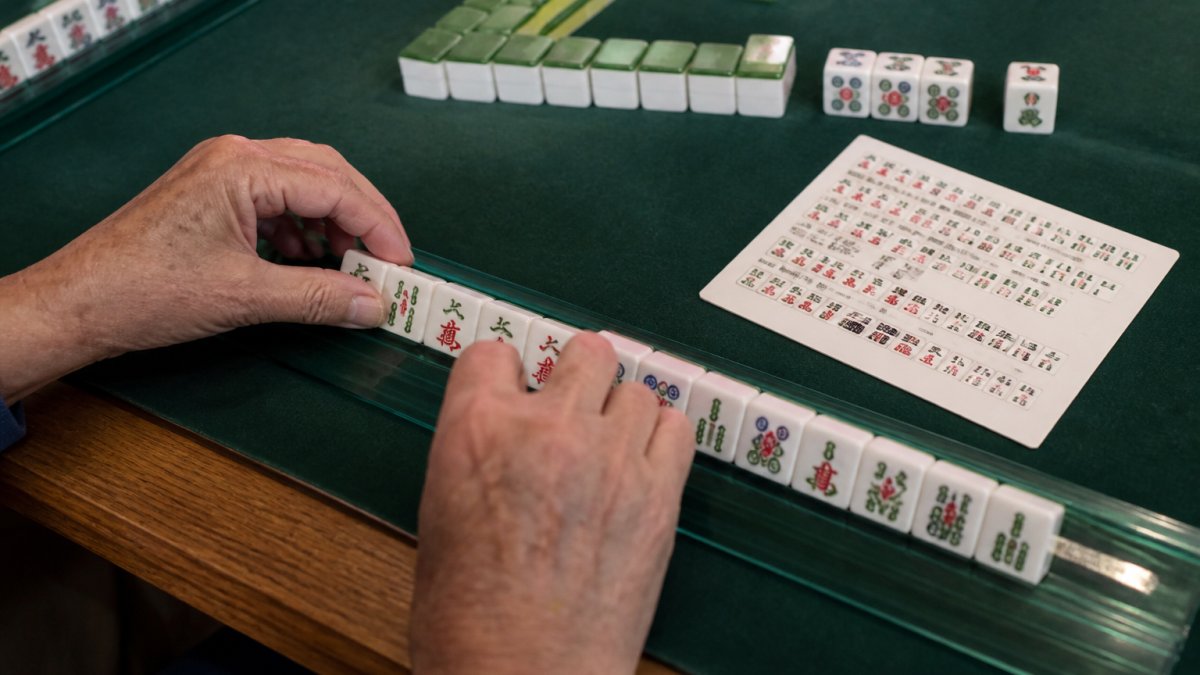
Count Your Matching Tiles
Start by counting how many tiles you already hold that match each pattern, the foundation of hand selection.
Go section by section and ask: "How many of these tiles do I already have?" A pattern with seven or eight matched tiles is far stronger than one with three.
This is where most players make their first mistake: they assume they're close to a pattern they like without counting.
Identify Your Strongest Candidates
After counting, patterns with five or more matching tiles are your candidates. Note their section numbers.
Compare them: which needs the fewest additional tiles, and are those tiles likely to be discarded or hoarded?
A strong candidate hand is one where:
- You have seven or eight tiles already
- The tiles you need are common tiles (not specialty tiles)
- You have flexibility to pick up different tiles and stay on track
A weak candidate is one where you have only four or five tiles and you need very specific tiles that other players might be keeping.
American Mahjong Hand Examples and Patterns
The fastest way to learn how to choose a hand is to watch the decision happen tile by tile. Below are three sample racks compared against plausible card patterns, with the reasoning spelled out.
When comparing two candidate patterns, score each on four factors:
- Matched tiles: How many tiles in your rack already fit the pattern.
- Needed tiles: How many specific tiles you still must acquire.
- Availability: Whether the tiles you need are still live (not heavily discarded, not obviously hoarded by opponents).
More matched tiles, fewer needed tiles, better availability, and higher flexibility wins. On a tie, prefer flexibility, it survives more of the tiles you'll actually draw.
Example 1: A near-complete hand
Suppose you're dealt: 1 Bam, 2 Bam, 3 Bam, 1 Crack, 2 Crack, 3 Crack, 5 Dot, 6 Dot, 7 Dot, East, South, West, North, and one Flower.
You scan the card and find three plausible patterns:
- Pattern A: Three runs, one in each suit, plus a pair. You already hold the Bam run, the Crack run, and the Dot run. You need a pair.
- Pattern B: Two runs plus a pair. You hold the Bam and Crack runs. You need a Dot run and a pair.
- Pattern C: Four pairs in honors. You hold East, South, West, North, four singles, zero pairs. You need four more matching honor tiles to form two pairs.
Score them:
| Pattern | Matched | Needed | Availability | Flexibility |
|---|---|---|---|---|
| A | 12 | 2 (a pair) | High, any pair works | High |
| B | 6 | 5 (a run + pair) | Medium | Medium |
| C | 4 | 8+ | Low, honors are contested | Low |
Pattern A is the clear choice: two tiles from a win, and almost any pair completes it. Commit and discard the Flower and unneeded honors.
Example 2: A workable but unfinished hand
Now suppose you're dealt: 1 Bam, 2 Bam, 3 Bam, 1 Crack, 2 Crack, 5 Dot, 6 Dot, 7 Dot, East, South, West, North, North, Dragon.
You find a pattern that needs three runs plus a pair. You hold:
- A complete Bam run (1-2-3)
- A partial Crack run (1-2, need 3)
- A complete Dot run (5-6-7)
Score it: 11 matched tiles, 3 needed (a 3 Crack plus a second pair). Availability is decent if Cracks are flowing.
This is a keeper, but weaker than Example 1. Pursue it, but if another pattern jumps to 10+ matched tiles later, re-score before committing further.
Example 3: Two candidates, one decision
Suppose you're dealt: 2 Bam, 3 Bam, 4 Bam, 5 Bam, 6 Bam, 2 Crack, 3 Crack, 4 Crack, 7 Dot, 8 Dot, 9 Dot, Red Dragon, Red Dragon, Green Dragon.
Two patterns compete:
- Pattern X: A five-tile Bam run plus a three-tile Crack run plus a pair. You hold the Bam run (2-3-4-5-6), the Crack run (2-3-4), and the Red Dragon pair. That's 10 matched tiles, 4 needed.
- Pattern Y: Three consecutive runs across suits plus a pair of Dragons. You hold the Bam run, the Crack run, and the Dot run (7-8-9), but your only Dragon pair is Red. That's 11 matched tiles, 3 needed.
On raw counts, Pattern Y looks better, but check availability. If two Red Dragons are already on the table, Pattern Y's pair is dead and you'd need a different Dragon pair.
This is the lesson: matched-tile count alone is not enough. Always check whether the specific tiles you need are still live before you commit.
When to Switch Hands in American Mahjong
Switching changes character as the game moves through three stages. Most players treat it as a gut call; strong players apply a different rule at each stage.
Early game (first 3-4 turns): stay flexible, do not commit
In the first few turns, hold two or three candidate patterns in mind and don't lock in. Gather information: what's discarded, what opponents expose, which suits flow.
Switch freely here, if a new pattern hits 8+ matched tiles while your original sits at 6, move. You've lost almost nothing.
Middle game (roughly turns 5-10): commit unless a clear upgrade appears
By the middle game, commit to one pattern and discard toward it. Switching now costs tiles you've already thrown away.
Apply a numeric trigger. Switch only if:
- The new pattern has at least 3 more matched tiles than your current one, AND
- The tiles you need for the new pattern are still live (fewer than two of each needed tile visible in discards), AND
- You have not already discarded a tile that the new pattern requires.
If all three conditions are not met, stay. Impatience is not a reason to switch.
Late game (last 4-5 turns): do not switch at all
In the late game, the wall is short and opponents are close to winning. Switching is almost always a losing move, you can't acquire enough tiles in the remaining draws. Push your committed hand or play defense with safe discards.
How discards and exposures change the decision
Visible information should override your raw tile count. Two adjustments matter most:
- Dead tiles. If the specific tile you need is already fully visible in discards (for example, all four copies of a 5 Bam are on the table), your pattern is dead. Switch immediately, regardless of stage.
- Contested tiles. If two or more opponents have exposed tiles in the same suit or honor group your pattern needs, your availability drops. Downgrade that pattern's score and favor a pattern in an uncontested suit.
Experienced players track which suits are "flowing" (discarded freely) and which are "held" (rarely appearing). When two candidates are otherwise equal, choose the one in the flowing suit, that adjustment wins more hands than any other switching rule.
When NOT to switch
- You are 7+ tiles matched and 2 or fewer tiles from a win.
- You have already discarded tiles the new pattern requires.
- The only reason you want to switch is that the current hand feels boring.
American Mahjong Discards Strategy and Hand Selection
Your hand choice affects what you discard, and your discards affect the whole table.
Once you've chosen your hand, discard tiles that fit none of your patterns, especially ones opponents are likely collecting.
Watch exposed tiles: if three 1 Bams are discarded, 1 Bams are flowing, and if you need them, adjust.
Your discards also signal what you're not keeping.
Strong players adapt to the table.
Common Mistakes When Choosing a Hand
Most players make the same errors over and over. Here's how to avoid them.
Mistake 2: Not counting carefully. You glance at a pattern, assume you're close, and halfway through realize you have four matched tiles, not seven.
Mistake 4: Ignoring what other players are doing. You pick an Honors hand while three opponents collect Honors too, with only 28 Honor tiles in the game, you'll rarely win.
Conclusion
Choosing a hand in American Mahjong is a skill you develop through practice, but the framework is simple: read the card, count your tiles, compare candidates, and commit to the strongest one, then stay flexible, switching only when a significantly better hand appears.
Consistent winners aren't the luckiest players, they make this decision deliberately. They count, compare, and adapt.
Bring this framework to your next game, our tools keep you organized and focused on choosing the right hand and playing it to win.
Frequently Asked Questions
How many tiles should match a hand before you commit to it in American Mahjong?
Most experienced players commit when they have 5-6 tiles that match a single hand on the card. Beginners should look for at least 4-5 matching tiles to stay flexible. The exact number depends on the game stage: early in the hand, you can afford to be selective; late in the hand, 3-4 matching tiles might be enough if the pattern is achievable. Always count the tiles you need to complete the hand and verify they're still available before committing.
When should you switch hands in American Mahjong?
Switch hands when your current choice is blocked by exposed discards or when you draw a tile that opens a stronger pattern. If you've committed to a hand and only need one or two specific tiles, stay with it unless those tiles are clearly unavailable. Switch early in the hand when you have flexibility, but avoid constantly changing hands, this wastes draws and leaves you without a solid plan. Late in the hand, commit to your best option and see it through unless circumstances dramatically change.
How can discards help you decide which hand to play in American Mahjong?
Watch what other players discard to understand which tiles are still in the wall and which are blocked. If multiple players have discarded the tiles you need, that hand becomes less viable. Exposed discards also tell you which hands your opponents are pursuing, helping you avoid competition for the same tiles. Use this information to choose a hand with needed tiles that haven't been heavily discarded, improving your odds of drawing what you need.
What should beginners look for when choosing an American Mahjong hand?
Start by finding a hand where you already have 4-5 matching tiles in your rack. Look for simple patterns like pairs or runs rather than complex combinations. Check the NMJL card carefully to ensure you understand the exact pattern required. Avoid hands that need many specific tiles or tiles that other players have already discarded. Pick one strong candidate and commit to it rather than juggling multiple options. As you gain experience, you'll develop faster pattern recognition and better judgment about tile availability.