
Table of Contents
- What to Look for in a Printable American Mahjong Hands Guide
- Printable American Mahjong Hands List: Free vs. Paid Options
- American Mahjong Beginner Hand Examples You Can Actually Use
- How to Build an American Mahjong Hand: Step by Step
- Print Quality, Page Size, and Accessibility Checklist
- Current-Year Card Compatibility and Accuracy Verification
- Common Mistakes to Avoid When Using Printable Guides
- Frequently Asked Questions
Last Updated: October 21, 2026
What to Look for in a Printable American Mahjong Hands Guide
A printable American Mahjong hands guide is a reference sheet or PDF that lists the hand patterns for the current year's card, formatted so you can print it and keep it beside your rack during play. Club players often ask: which guide is actually worth printing, and which one will leave you guessing mid-hand?
The difference comes down to four things: accuracy against the current card, readable layout, print quality, and whether the guide teaches you to build hands rather than just copy them.
Here is the short version:
- Accuracy first. A guide that lists last year's patterns is worse than no guide at all.
- Layout second. Patterns should be grouped by section (like the card itself), not alphabetized.
- Print quality third. Small tiles and thin fonts turn unreadable on a home printer.
- Teaching value last. The best guides show you how to group tiles, not just what to collect.
Below, we break down free versus paid options, walk through real beginner hand examples, and show you exactly how to build a hand step by step.
Printable American Mahjong Hands List: Free vs. Paid Options
Most printable hands lists fall into one of four buckets, and the bucket matters more than the price. Here is how they actually differ on the things that affect play: accuracy against the current card, layout, coverage, and value.
| Option | Typical Cost | Accuracy Risk | Layout & Coverage | Best For |
|---|---|---|---|---|
| Free forum or Pinterest PDF | Free | High, often undated and built for an older card | Single-column lists, minimal tile graphics, no rules reference | Casual players who already know the card |
| Club-shared list | Free | Medium, depends on the club's update habit | Photocopied, sometimes hand-annotated, varies by group | Established club members |
| Paid printable bundle | Varies by seller; commonly in the low tens of dollars | Low if the seller names the card year and updates annually | Color-coded sections, larger tile symbols, Charleston cheat sheet | Weekly players and club organizers |
| Official card | Sold by the national organization | None, it is the source of truth | Not a printable guide, but the authority every guide should match | Tournament play and verification |
How to judge value without overpaying. A paid bundle is worth it when it saves you misreads, not when it looks pretty. Ask three questions before buying: Does the listing name the current card year? Does it show a sample page at full size so you can judge tile legibility? Does the seller state how annual updates are handled? A "yes" to all three is a reasonable value signal; a "no" to any one is a reason to keep looking.
What free options are genuinely good for. A free list is fine as a second copy, one for the game bag, one taped inside a binder, as long as you verify it against your physical card before your first game of the season. Free lists are also the right choice if you play a few times a year and already know the patterns cold.
The comparison most guides skip. Lay two candidate guides side by side and check the same three patterns in each. The guide that matches the card on all three, groups patterns by card section, and prints legibly in black and white is the better guide, regardless of whether it was free or paid. Price tells you what the seller thinks it is worth; the side-by-side check tells you what it is actually worth to you.
American Mahjong Beginner Hand Examples You Can Actually Use
Beginner-friendly hands share a trait: they use few jokers and rely on simple groupings. Here are three patterns worth learning first, described in plain terms so you can spot them on any hands list.
The pair-and-pung hand. Collect one pair and three sets of three matching tiles. This is the simplest hand structure in the game and the one most new players complete first.
The run-based hand. Build sequences within a single suit, such as three consecutive numbers. Runs feel natural if you've played other tile games.
The all-one-suit hand. Keep every tile in a single suit plus a pair. Harder to complete, but easy to recognize, which matters when you're scanning a crowded hands list under time pressure.
For a fuller picture of how the game is structured, the official National Mah Jongg League rules overview is the reference point most clubs follow.
How to Build an American Mahjong Hand: Step by Step
Building a hand is a process of narrowing choices, not collecting randomly. Here is the sequence we recommend to new players.
Step 1: Deal and sort. Group your tiles by suit, then by number. Pull winds, dragons, flowers, and jokers to the side.
Step 2: Read the Charleston. The first Charleston draw and second Charleston draw let you pass unwanted tiles. Use them to dump tiles that fit no hand you're considering.
Step 3: Choose a target hand. Pick two candidate patterns from the hands list, not one. You need a backup.
Step 4: Track your gaps. Count how many tiles you still need for each candidate. Whichever needs fewer, commit to it.
Step 5: Call tiles carefully. Exposing a set locks you into a direction. Wait until the hand is close.
Step 6: Reassess after every draw. If a better pattern opens up, switch early, not late.
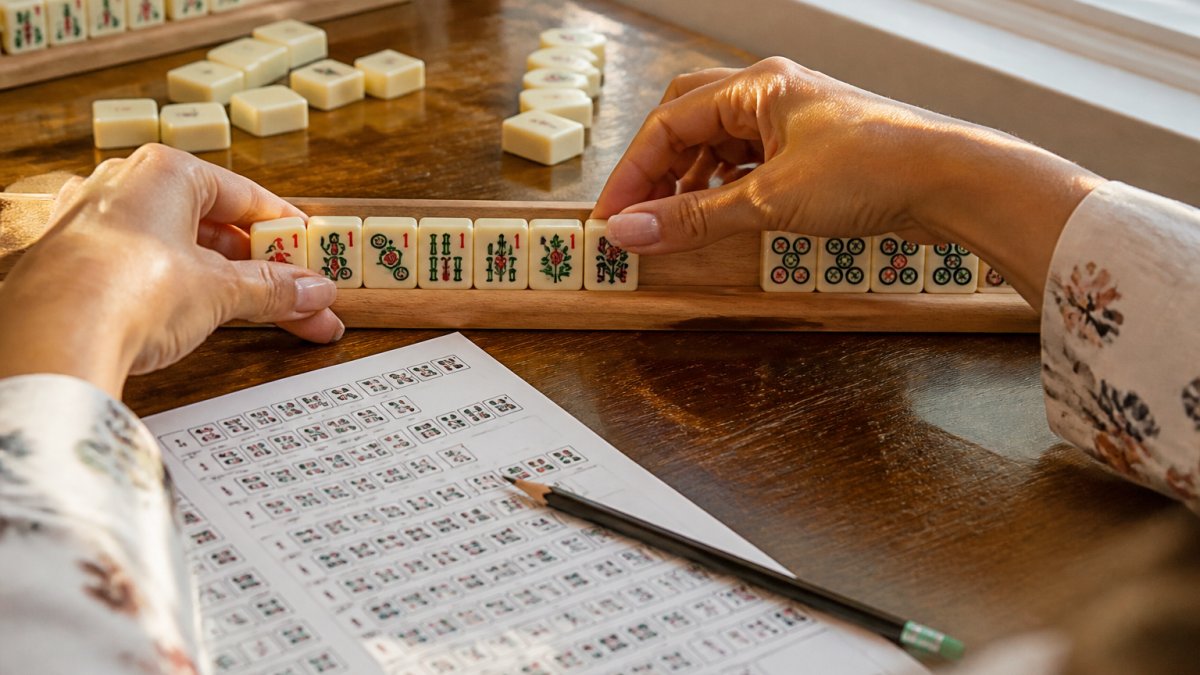
Print Quality, Page Size, and Accessibility Checklist
Print quality decides whether a guide is usable or decorative. Run through this checklist before you commit a guide to your game bag:
- Tile symbols are legible at arm's length without squinting
- Patterns are grouped by card section, matching the official card layout
- Text is at least 11-point, with high contrast
- Page size fits a standard binder sleeve (letter size prints cleanly)
- Color coding survives black-and-white printing
- Jokers and flowers are visually distinct from number tiles
- The file opens and prints without special software
That last item matters more than people expect. If a download requires a specific app, printing at a club meeting becomes a hassle. Standard PDF files are the safest bet, as the Adobe PDF accessibility guidance notes for readable document design.
Current-Year Card Compatibility and Accuracy Verification
Card compatibility is the single most overlooked issue with printable guides. American Mahjong hands change with each new card, and a guide built for an older card will quietly steer you toward patterns that no longer exist. The fix is a repeatable verification routine, not a one-time glance.
A five-minute verification routine. Run this before you trust any guide, free or paid:
- Find the stated card year. If the guide does not name one, treat it as outdated until proven otherwise.
- Cross-reference three patterns across different sections of your physical card, pick one from the first section, one from the middle, and one from the last. A guide that matches all three is likely built from the current card; a single mismatch is a stop sign.
- Check the revision date on the download page or in the file properties. A recent revision date is a good sign; a missing one is a caution flag.
- Confirm the seller's update policy. Sellers who update annually usually say so on the listing. If the policy is unclear, ask before buying.
- Re-verify at the start of each card season. Set a calendar reminder for the month the new card typically arrives and refresh your guide then.
How to review a guide's accuracy like an experienced player. Rather than trusting a single source, compare the guide against the card section by section and note any pattern where the tile count, suit, or grouping differs. Errors often cluster in the denser sections of the card, where small layout differences are easy to miss. Keep a short list of any mismatches and check whether the seller has issued a correction.
A transparent review method you can copy. When comparing two guides, score each on four criteria: card-year match (does it name the current year?), pattern coverage (does it include every section of the card?), layout fidelity (are patterns grouped the way the card groups them?), and legibility (can you read the tile symbols at arm's length?). A guide that scores well on all four is the one to keep in your game bag.
Common Mistakes to Avoid When Using Printable Guides
The first mistake is treating a printable guide as a substitute for the card. It isn't. The card is the authority; the guide is a study aid.
The second is printing once and never updating. Set a reminder when the new card season arrives and refresh your guide then.
The third is choosing a guide with beautiful design and unreadable tiles. Aesthetics lose to legibility every time at the table.
The fourth is ignoring the Charleston when studying. A hands list tells you what to build; the Charleston tells you how to get there.
If you want Mahjong-themed printables for the social side of the game, our Library of Congress guide to games and recreation collections offers useful background on how game traditions are documented, which is a fun rabbit hole for club historians.
Printable guides work best when they're accurate, legible, and paired with real practice at the table. At AmericaMahjongfun.com, we make instant digital downloads for the social side of the game: retro-inspired greeting cards, printable party game bundles, and Mahjong-themed organizers for club meetings and milestones. Every file is ready to print the same day you buy it, so your next club gathering can have something special without the wait. Browse our printable collection and bring a little extra joy to your next Mahjong occasion.
Frequently Asked Questions
What should a printable American Mahjong hands guide include?
A good guide should include the full hand list for the current year's card, clear visual examples of each pattern, and beginner-friendly notes on grouping tiles. Look for a printable reference that shows suits, numbers, winds, dragons, and flowers, plus a cheat sheet for quick pattern recognition. It should also indicate whether it matches the current American Mahjong card, so you don't practice outdated hands.
How do I choose a guide that matches the current American Mahjong card?
Check the publication year on the guide and compare it to the card year you play with. Most guides state the card year on the cover or first page. If it doesn't, ask the seller or look for a version note. A current-year printable American Mahjong hands list will save you from memorizing patterns that are no longer valid, and it keeps your practice sessions aligned with real games.
Are printable American Mahjong hand examples useful for beginners?
Yes, especially when they show the tiles laid out visually. Beginner hand examples help you see how pairs, runs, and sets come together. Pair a printable guide with actual tiles to practice grouping. Start with simpler patterns like a single suit with consecutive numbers, then move to hands that use winds or dragons. Regular practice with examples builds pattern recognition faster than reading rules alone.
Can I print an American Mahjong cheat sheet for practice?
Absolutely. A cheat sheet is one of the most practical printable tools. Print it on letter-size paper, keep it in your tile bag, and refer to it during practice games. Many players laminate theirs for durability. Use it to review hand patterns before club meetings, and soon you'll recognize common hands without looking. Just make sure the cheat sheet reflects the current card year.